Asia
Chicken Katsu: Crisp Panko Cutlets with Tonkatsu Sauce
Pounded chicken cutlets coated in panko and shallow-fried until crisp, served with cabbage, rice and a quick pantry tonkatsu-style sauce.
By Lavin Food Editorial · Published
- Prep
- 30 min
- Cook
- 25 min
- Total
- 55 min
- Yield
- 4 servings
About this dish
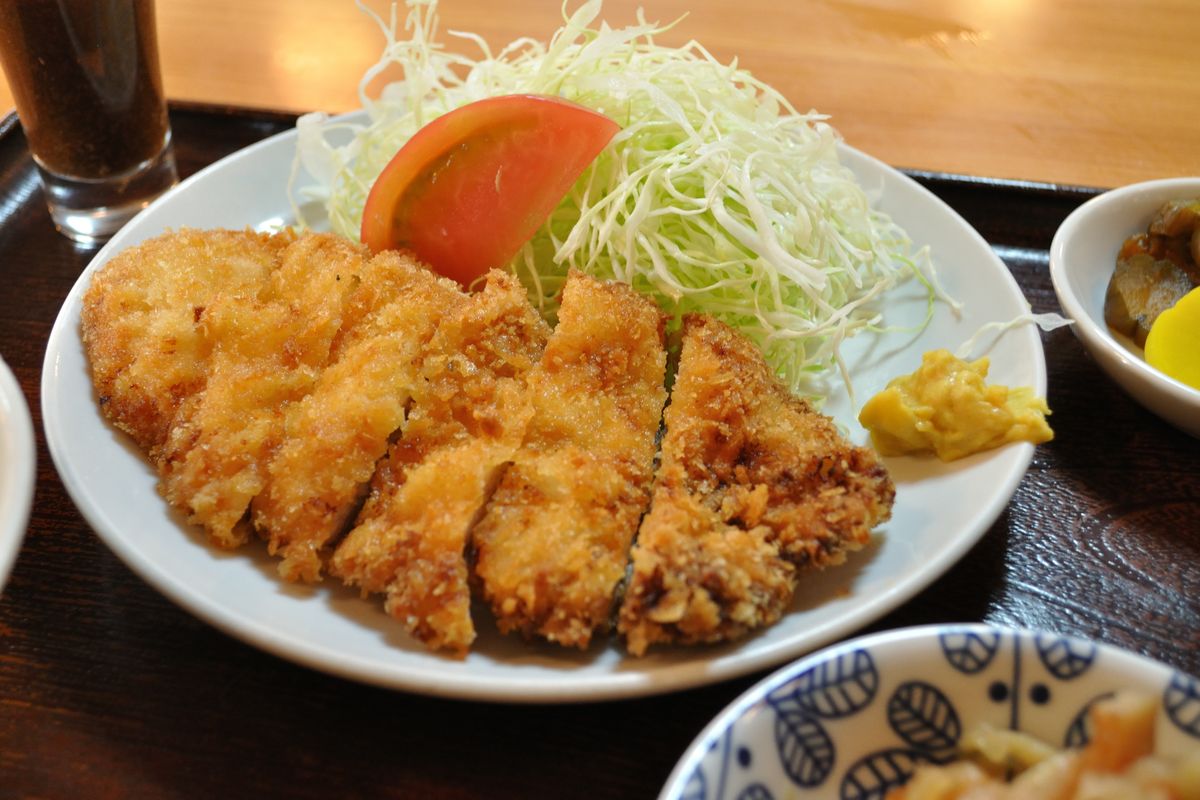
Chicken katsu is a boneless chicken cutlet coated in panko, fried until deep gold and sliced into strips. It comes with a dark, tangy sauce, shredded cabbage and rice. Wikipedia explains that katsu is short for katsuretsu, an old Japanese rendering of the word "cutlet", which came from the French côtelette. It adds that chicken katsu often appears in Hawaiian plate lunches, and that chicken katsu curry has become very popular in the United Kingdom.
Katsu belongs to yōshoku, the Western-influenced style of Japanese cooking that began in the Meiji era (1868 to 1912). Wikipedia says early katsuretsu were made with beef, chicken and pork, and that the pork version became the direct ancestor of modern tonkatsu, credited to a Tokyo restaurant named Rengatei in 1899. The sources read for this page give no date for chicken katsu itself, so no claim is made about it.
The crunch comes from panko, a flaky breadcrumb made from crustless bread that is baked with an electric current and ground into slivers. It stays light when fried or baked. This version uses chicken breast pounded flat, a shallow fry in about 1/2 inch (1.25 cm) of oil, and a quick sauce from pantry staples. The sauce is a stand-in for bottled tonkatsu sauce, a thick Worcestershire-style sauce, so the flavor is close but not identical.
Ingredients and substitutions
Quantities are for 4 servings.
For the chicken
- 1½ pounds (680 g) boneless, skinless chicken breasts, about 2 large
- ¾ teaspoon (4 g) fine salt
- ¼ teaspoon (0.5 g) freshly ground black pepper
For the coating and frying
- ½ cup (60 g) all-purpose flour
- 2 large eggs, beaten with the water
- 1 tablespoon (15 ml) water
- 2 cups (100 g) panko breadcrumbs
- 2 cups (480 ml) neutral oil, such as canola or vegetable oil
For the quick tonkatsu-style sauce
- ¼ cup (60 ml) ketchup
- 2 tablespoons (30 ml) Worcestershire sauce
- 2 teaspoons (10 ml) soy sauce
- 2 teaspoons (8 g) sugar
To serve
- 3 cups (210 g) green cabbage, cored and shredded very thin
- 1½ cups (280 g) short-grain rice, cooked to package directions
- lemon wedges, optional
Choosing your ingredients
Chicken breast is lean and dries out fast unless the cutlets are thin and even. Slice each breast in half horizontally, then pound the pieces to about 1/2 inch (1.25 cm). Boneless, skinless thighs are juicier and more forgiving, and work the same way.
Use true panko if you can. Its large, flaky slivers make a crust that shatters when you bite it, while fine sandy crumbs give a denser, flatter crust. Keep the bag closed, since stale panko soaks up more oil.
Choose a neutral oil with a high smoke point, such as canola or peanut oil. A heavy 10-inch (25 cm) skillet fits two cutlets at a time. The oil should reach about halfway up the cutlet, around 1/2 inch (1.25 cm), so the amount depends on your pan. A thermometer helps, because oil temperature decides whether the crust turns crisp or greasy.
Make the sauce first so the flavors blend. Ketchup brings sweetness and body, Worcestershire sauce adds tang, soy sauce adds salt and the sugar rounds it off. Shred the cabbage as fine as you can, since thick shreds are chewy.
Possible substitutions
- Chicken breasts: Boneless, skinless thighs, 1.5 pounds (675 g). Pound lightly and add about a minute per side.
- Panko breadcrumbs: Plain dry breadcrumbs. The crust will be denser, so press it on gently.
- All-purpose flour: Rice flour or cornstarch, with gluten-free panko, for a gluten-free coating.
- Worcestershire sauce: 1 tablespoon (15 ml) soy sauce plus 1 tablespoon (15 ml) cider vinegar. Taste and add a pinch more sugar if sharp.
- Green cabbage: Thinly sliced romaine or cucumber. The cold crunch is the point.
Step-by-step method
- Make the sauce and shred the cabbage. Stir the ketchup, Worcestershire sauce, soy sauce and sugar together for about a minute, until the sugar dissolves and the sauce looks smooth and glossy. Shred the cabbage very thin and chill it. Start the rice now so it is ready when the chicken is.
- Slice and pound the chicken. Press a hand flat on a breast and slice it in half horizontally. Place each piece between sheets of plastic wrap or parchment. Pound with a rolling pin or heavy pan, working from the center out, for about 1 minute per piece, until it is an even 1/2 inch (1.25 cm) thick.
- Season and set up the station. Pat the cutlets dry and season both sides with the salt and pepper. Set out three shallow dishes: flour, then the eggs beaten with the water, then the panko. Put a wire rack on a baking sheet at the end of the line to hold the breaded cutlets.
- Bread the cutlets. Use one hand for dry steps and the other for wet. Dredge a cutlet in flour and shake off the excess. Dip it in egg, let the extra drip off, then press it into the panko until no wet patches show. Set it on the rack. This takes about 5 minutes. Wash your hands afterward.
- Heat the oil. Heat the oil over medium to medium-high heat for 3 to 5 minutes, until it reads 340 to 350°F (170 to 175°C). With no thermometer, drop in one panko crumb: it should sizzle steadily, not burn. Keep a lid nearby and never leave hot oil unattended.
- Fry on both sides. Lay two cutlets in the oil, placing them away from you to avoid splashes. Fry 3 to 4 minutes, until the underside is deep golden. Turn with tongs and fry 3 to 4 minutes more. Hold the oil near 340°F (170°C), letting it recover between batches. The thickest part must reach 165°F (74°C).
- Rest, slice and serve. Move the cutlets to a clean wire rack, not paper towels, and rest them 3 to 5 minutes so the crust stays crisp. Slice crosswise into strips about 3/4 inch (2 cm) wide with a sawing motion. Serve over rice with cabbage, sauce and a lemon wedge, while the crust still crackles.
Variations
To bake instead of fry, heat the oven to 425°F (220°C) and set a rack on a baking sheet. Toss the panko with 3 tablespoons (45 ml) of oil so it browns evenly, then bread the cutlets as above. Bake 18 to 22 minutes, turning once, until golden and 165°F (74°C) in the center. The crust is drier than a fried one but still crunchy.
Wikipedia describes tonkatsu served with Japanese curry as katsu curry, and simmered with egg and broth over rice as katsudon; a chicken cutlet fits either. For a sandwich, tuck a cutlet between soft white bread with cabbage and sauce. For a filled cutlet, put a slice of cheese between two thin pieces of chicken before breading.
Storage and reheating
Chicken katsu is best eaten within minutes, while the crust is crisp. Refrigerate leftovers within two hours of cooking (one hour if the room is above 90°F or 32°C). Keep them in a shallow airtight container for 3 to 4 days, with the sauce and cabbage stored separately.
Reheat on a rack in a 400°F (200°C) oven for 8 to 12 minutes, until the crust crisps and the center is steaming hot at 165°F (74°C). The microwave turns the crust soft. Cooked cutlets freeze for about 3 months; thaw them overnight in the refrigerator first.
Common mistakes
- Uneven cutlets. A thick end and a thin end cook at different speeds, so one part dries out. Pound the chicken to an even 1/2 inch (1.25 cm).
- Using both hands for everything. Wet fingers clump the flour and panko into lumps that fall off in the oil. Keep one hand dry and one wet.
- Oil that is too cool or too hot. Below 340°F (170°C) the crust turns greasy. Above 350°F (175°C) it browns before the chicken cooks through. Use a thermometer and fry in small batches.
- Resting on paper towels. Steam gets trapped under the cutlet and softens the bottom crust. A wire rack keeps both sides crisp.
- Going by color alone. A golden crust does not prove the chicken is safe. Check that the thickest part reaches 165°F (74°C).
Frequently asked questions
What is the difference between chicken katsu and tonkatsu?
Tonkatsu is made with pork, usually loin or fillet. Chicken katsu uses the same flour, egg and panko method on a chicken cutlet. Both are served with cabbage, rice and a thick brown sauce.
Can I bake the cutlets instead of frying?
Yes. Toss the panko with a little oil, bread the cutlets and bake on a rack at 425°F (220°C) for 18 to 22 minutes, turning once. The chicken must still reach 165°F (74°C).
How do I keep the coating on?
Pat the chicken dry first, shake off extra flour and egg, and press the panko on firmly. Let the breaded cutlets sit a few minutes, and turn them only once in the pan.
What do I do with the leftover oil?
Let it cool fully, strain it through a fine sieve and store it in a sealed container. Use it once or twice more. Discard it if it is dark, smells off or foams. Never pour it down the drain.