European Classics & Core Techniques
Homemade Chicken Stock: A Base for Soups, Sauces and Risotto
Chicken bones, vegetables and herbs simmered gently for 3 to 4 hours, left unsalted so it can go into soups, sauces and risotto.
By Lavin Food Editorial · Published
- Prep
- 20 min
- Cook
- 3 hr 30 min
- Total
- 3 hr 50 min
- Yield
- 8 cups
About this dish
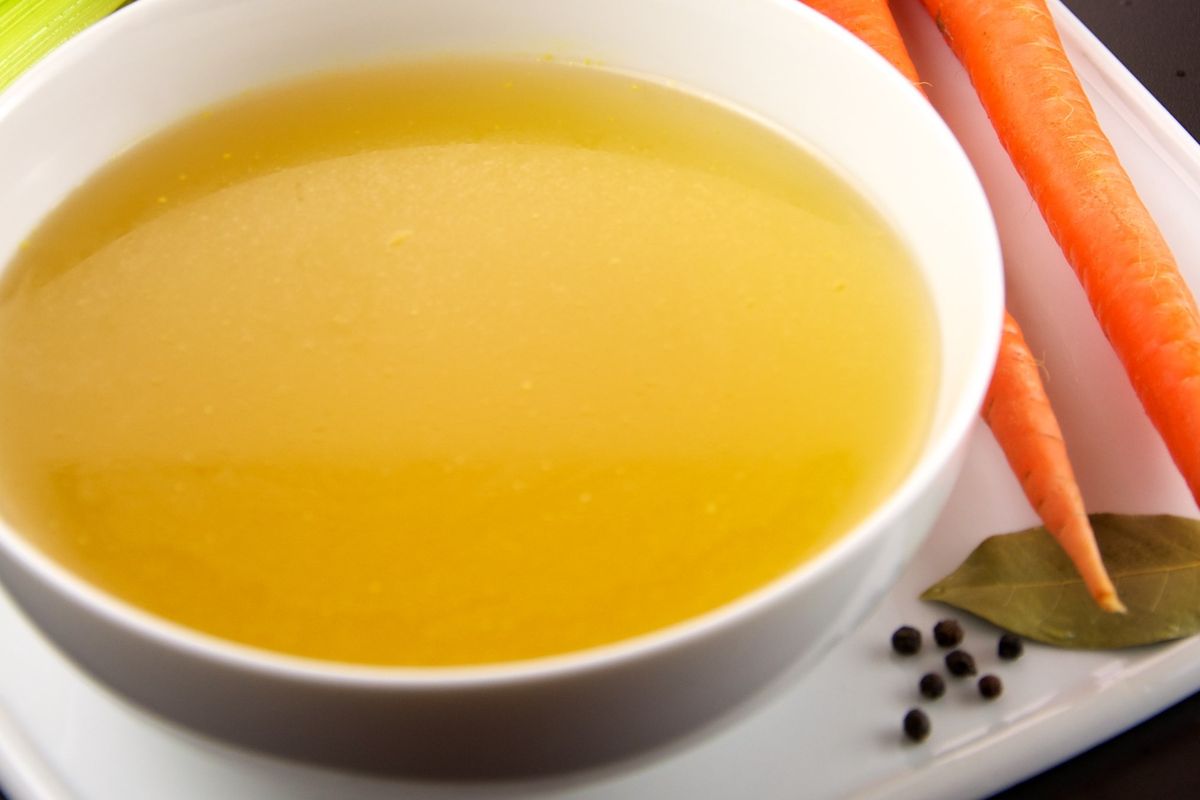
Chicken stock is a savory cooking liquid made by simmering chicken bones, and often some meat, in water with a few vegetables and herbs. Wikipedia describes stock as the base of many dishes, particularly soups, stews and sauces. It is rarely served alone. Its job is to give a dish body and a savory backbone that plain water cannot.
The flavor comes from the bones, the cartilage and the connective tissue around them. That tissue contains collagen, which turns into gelatin as it simmers. Gelatin is why good stock feels a little silky and why it can set to a jelly in the refrigerator. Classical kitchens separate white stock, made from raw bones, from brown stock, made from roasted bones. This page makes the white kind.
Cooks do not agree on where stock ends and broth begins. Many use the words as synonyms, and James Beard wrote in 1974 that stock, broth and bouillon are all the same thing. Where a line is drawn, one idea is that stock is left unseasoned for use in other recipes, while broth is salted for sipping. This recipe follows that idea. The salt is left out so you can reduce the stock later without it turning harsh. Sources are listed at the end.
Use the finished stock for soup, pan sauces, gravy, braises and risotto. Most of the work is patience, a low flame and careful cooling.
Ingredients and substitutions
Quantities are for 8 cups.
For the stock
- 3 pounds (1.35 kg) chicken wings, backs or carcasses, raw, or a leftover roasted carcass plus raw wings
- 10 cups (2.4 L) cold water, enough to just cover the bones
- 1 large (280 g) yellow onion, halved, skin on is fine
- 2 medium (150 g) carrots, scrubbed, cut in big chunks
- 2 large (100 g) celery stalks, with leaves, cut in big chunks
- ¼ cup (15 g) parsley stems
- 2 dried bay leaves
- 1 teaspoon (3 g) black peppercorns
- 4 sprigs fresh thyme, optional
- 4 cloves garlic, optional, halved crosswise
Choosing your ingredients
Wings, necks, backs and the carcass from a roasted chicken all make good stock. Wings carry plenty of cartilage and skin, so they give the most body. Raw bones give a clean, light stock, and a roasted carcass adds a toastier note. A pot made only from a picked-over carcass has less connective tissue, so expect it to set less firmly.
The vegetables follow the classic mirepoix of onion, carrot and celery. Leave the pieces large, since a long simmer would turn small ones to mush. Scraps such as carrot peels, celery tops and onion ends work well, because everything is strained out at the end. Skip potatoes, which cloud the liquid.
Parsley stems, bay and thyme are a simple bouquet garni, the herb bundle of classical cooking. Stems have more flavor than leaves and cost nothing. Peppercorns stay whole.
Use a 6-quart (5.7 L) pot. The bones should sit snugly, with the water covering them by about 1 inch (2.5 cm). Too much water makes a thin stock. Do not add salt, because salt concentrates as stock reduces. Season the dish you make with it instead.
Possible substitutions
- Chicken wings: Backs, necks or a roasted chicken carcass. Use at least 2 pounds (900 g) of bones for this amount of water.
- Fresh thyme: 1/2 teaspoon dried thyme, or leave it out. The stock is fine without it.
- Celery: A leek top, washed well, or a few more celery leaves.
- Parsley stems: A small handful of parsley leaves, for a grassier flavor.
- Black peppercorns: Leave them out. Do not use ground pepper, which clouds the liquid.
Step-by-step method
- Rinse and load the pot. Rinse the bones under cold water and put them in the pot with all the vegetables and herbs. Pour in the cold water until it covers everything by about 1 inch (2.5 cm). This takes 5 to 10 minutes. Starting cold lets the proteins release slowly, which helps keep the stock clear.
- Bring it up slowly. Set the pot over medium heat, uncovered. Let it come up to temperature for 20 to 30 minutes, without stirring. Small bubbles appear at the edge, then a gray foam gathers on the surface. Do not let the pot reach a rolling boil, because boiling churns fat and bits into the liquid and makes it cloudy.
- Skim the foam. Use a wide spoon or ladle to lift the foam off and drop it into a bowl. Do this during the first 20 to 30 minutes of the simmer, and again whenever a new layer builds up. The surface should look fairly clear when you are done. A little floating fat is fine for now.
- Hold a bare simmer. Lower the heat until only a bubble or two breaks the surface every second or two, about 180 to 200°F (82 to 93°C). Simmer for 3 to 4 hours, uncovered or with the lid ajar. If the bones poke above the water, add hot water to cover them again. Do not stir.
- Check for doneness. After 3 hours, taste a spoonful. It should smell of chicken and taste savory and rounded, not watery. The bones should feel brittle and the wing cartilage should be soft. If it still tastes thin, give it another 30 to 60 minutes. Past 4 hours, the flavor gains little.
- Strain. Turn off the heat. Lift out the large bones and vegetables with tongs. Set a fine-mesh strainer over a large bowl and pour the stock through in batches, taking 10 to 15 minutes. Do not press on the solids, since that pushes cloudy bits through. Discard the solids.
- Cool it fast. Do not leave a full pot of hot stock on the counter. Pour the stock into shallow containers, or set the bowl in a sink of ice water and stir every few minutes for 30 to 45 minutes, until it stops steaming and feels cool. Refrigerate it within 2 hours of the end of cooking.
- Chill, de-fat and portion. Refrigerate the stock for 6 to 8 hours, or overnight. A layer of white fat will harden on top; lift it off with a spoon. If the stock has set to a wobbly jelly under the fat, it has plenty of gelatin and will melt when heated. Divide it into containers in the amounts you usually cook with.
Variations
For a brown stock, roast the bones and vegetables first at 425°F (220°C) for 35 to 45 minutes, until deeply golden, then simmer as above. Brown stock is darker and more roasted in flavor. For a quick stock, use a cooked carcass cut into smaller pieces and simmer for 1 to 1 1/2 hours. It tastes lighter and sets less firmly, but it works for soup tonight.
A second stock made from the same bones is known as a remouillage. Cover the used bones with fresh cold water, simmer for 2 to 3 hours and strain. It will be weaker, so use it where a gentle stock is enough. A pressure cooker also shortens the time needed; follow the maker's instructions.
Storage and reheating
Cool the stock quickly and refrigerate it within 2 hours of cooking. It keeps in a covered container in the refrigerator for 3 to 4 days. For longer storage, freeze it in 1 cup (240 ml) or 2 cup (480 ml) portions, leaving about 1 inch (2.5 cm) of space at the top for expansion. Frozen stock keeps its best quality for about 3 months.
Freeze a little in an ice cube tray for small sauce jobs. Thaw stock in the refrigerator, not on the counter. When you reheat it, bring it to a full boil, then lower the heat.
Common mistakes
- Boiling the pot. A hard boil churns fat and small particles into the liquid and leaves the stock cloudy and greasy. Keep it to a bare simmer.
- Skipping the skim. Foam left on the surface breaks up into the liquid as it simmers and clouds the stock. Lift it off during the first 30 minutes.
- Salting at the start. Salt stays behind when stock reduces, so a salted stock gets saltier as it concentrates. Leave it unseasoned and season the finished dish.
- Cooling the pot on the counter. A large, deep pot stays warm in the center for hours, which is a risk for bacterial growth. Split it into shallow containers or use an ice bath.
- Using too much water. Extra water means a thin stock that will not set. Cover the bones by about 1 inch (2.5 cm), no more.
Frequently asked questions
What is the difference between stock and broth?
Sources say the line is not fixed, and many cooks use the words interchangeably. Where a distinction is made, stock is often the unseasoned base for other dishes, while broth is salted and can be eaten alone.
Why did my stock turn to jelly?
Collagen in the bones turns to gelatin as it simmers, and gelatin sets when cold. The jelly melts back to liquid when heated.
Can I use a slow cooker?
Yes. Cover the bones with cold water and cook on low for 8 to 10 hours. Strain and cool as in the recipe.
Why is my stock cloudy?
Common causes are a boil, stirring, pressing the solids while straining, or skipping the skim. Cloudy stock still tastes fine.
Can I use bone-in thighs for stock and meat?
Yes. Simmer them for 45 to 60 minutes, until the meat reaches 165°F (74°C). Lift them out, pull the meat off, and return the bones to the pot to finish.