Mediterranean
Gigantes Plaki: Greek Baked Giant Beans in Tomato Sauce
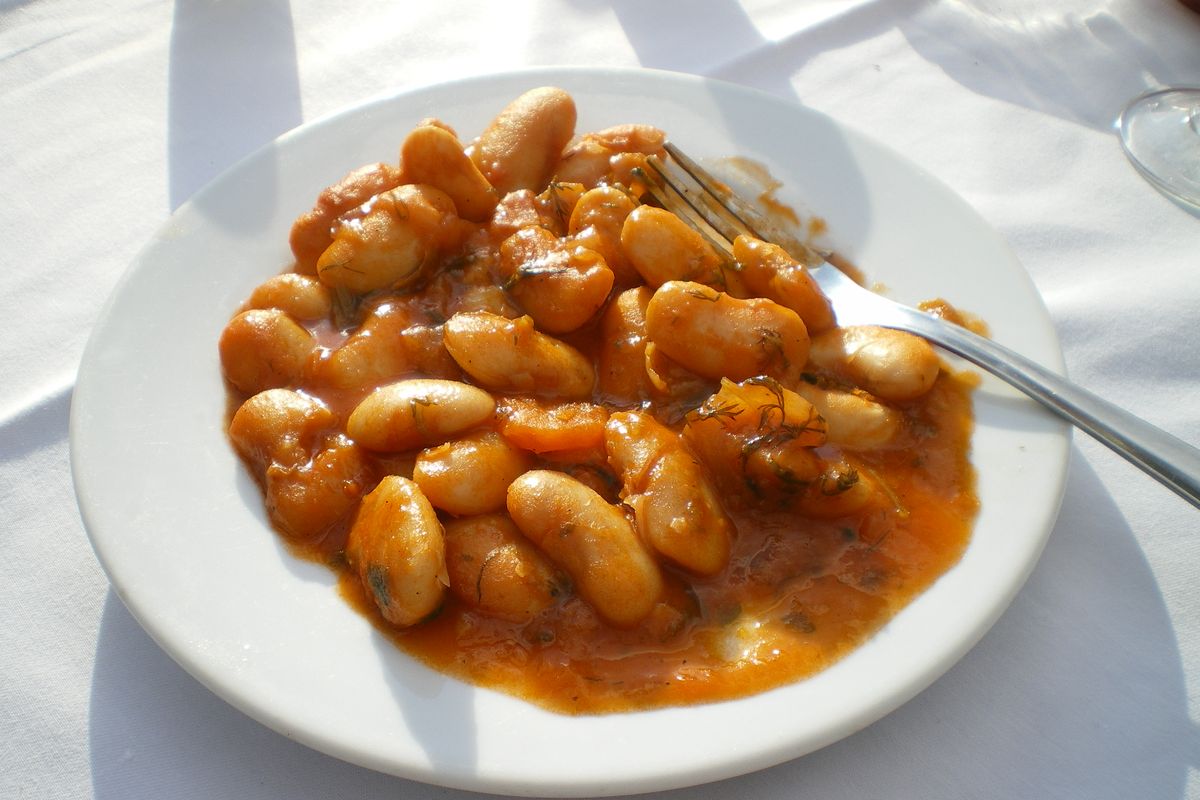
Giant white beans boiled until tender, then baked in a dill and tomato sauce until the top browns. Soak overnight, bake about an hour.
By Lavin Food Editorial · Published
- Prep
- 30 min
- Cook
- 2 hr 30 min
- Total
- 3 hr
- Yield
- 6 servings
About this dish
Gigantes plaki is a Greek dish of large white beans baked in a tomato sauce. Gigantes is Greek for "giants," and fasolia gigantes means "giant beans." Plaki dishes are baked with olive oil, tomatoes, vegetables and herbs. It can be a main dish or part of a meze spread, and it is often described as popular in autumn and winter.
The beans traditionally used are fasolia gigantes, a white-seeded type of runner bean (Phaseolus coccineus). Wikipedia notes that they are grown under protective law in parts of northern Greece. Large lima beans are sometimes used instead, which is also the practical choice outside Greece. The classic dish has no meat, so it suits Orthodox Christian fast days, although some cooks add sausage or smoked pork.
The sources read for this page do not say when or where the dish began, so it makes no claim about its early history. They do describe the method used here: soak and boil the beans, cook a sofrito, mix, and bake until the top browns.
Ingredients and substitutions
Quantities are for 6 servings.
For the beans
- 1 pound (450 g) dried gigantes or large lima beans, soaked overnight
- 2 leaves bay leaves
For the sauce
- ¼ cup (60 ml) olive oil
- 2 medium (300 g) yellow onions, finely chopped
- 2 medium (130 g) carrots, peeled and thinly sliced
- 4 cloves garlic, minced
- 1 tablespoon (15 g) tomato paste
- 28 oz (800 g) canned crushed tomatoes
- 1 teaspoon (1 g) dried oregano
- 1½ teaspoons (9 g) fine salt
- ½ teaspoon (2 g) sugar, optional, only if the tomatoes taste sharp
- 1 cup (240 ml) bean cooking liquid or water
- freshly ground black pepper, to taste
To finish
- ¼ cup (10 g) fresh dill, chopped
- ¼ cup (15 g) fresh flat-leaf parsley, chopped
- 2 tablespoons (30 ml) extra-virgin olive oil, for drizzling
- ½ cup (75 g) feta cheese, crumbled, optional
- crusty bread, for serving
Choosing your ingredients
True gigantes are large, flat, white beans with thin skins, sold dried by Greek and Mediterranean grocers. Check the date on the bag. Very old dried beans can stay hard for hours, however long you cook them.
Large lima beans, often sold as butter beans, are the common substitute. They are creamier and more floury than gigantes, so they soften sooner and break more easily. Gigantes stay firmer and meatier.
Canned crushed tomatoes give a steady sauce all year. Choose a plain can with no added herbs or sugar. The carrots add a gentle sweetness that balances the acidity.
Add the dill and parsley at the end, because long heat dulls fresh herbs. Cook with a mild olive oil and keep the best bottle for the final drizzle.
Possible substitutions
- Gigantes beans: Large lima beans (butter beans). They are creamier and cook faster, so start testing at 40 minutes.
- Dried beans: About 3 cans (15 oz, or 425 g each) of butter beans, drained and rinsed. Skip the soaking and boiling and bake 25 to 30 minutes. They are softer and break more easily.
- Canned crushed tomatoes: 2 pounds (900 g) very ripe fresh tomatoes, grated, skins discarded. Simmer the sauce 10 to 15 minutes longer.
- Fresh dill: More parsley and a little fresh mint. Dried dill is weak, so use only 1 teaspoon with the oregano.
- Feta cheese: Leave it out for a fully plant-based dish.
- Sugar: Leave it out, or add one more grated carrot with the onions.
Step-by-step method
- Soak the beans. Rinse the beans and pick out any stones or broken ones. Put them in a large bowl and cover with cold water by at least 3 inches (7 cm), because they swell to more than double their size. Soak for 8 to 12 hours at room temperature. Add no salt. The beans are ready when they look plump and smooth, with no wrinkles.
- Boil the beans gently. Drain the beans and put them in a large pot with the bay leaves. Cover with fresh water by 2 inches (5 cm). Bring to a boil, then lower the heat until the water barely bubbles. Simmer 45 to 75 minutes. Do not boil hard, which splits the skins, and add no salt or tomato yet. A bean is done when it mashes easily between your fingers and has no chalky center.
- Drain and heat the oven. Scoop out and keep about 1 cup (240 ml) of the cooking liquid, then drain the beans gently. Discard the bay leaves. Heat the oven to 375°F (190°C) with a rack in the middle. Choose a baking dish about 9 by 13 inches (23 by 33 cm), so the beans sit in a layer about 2 inches (5 cm) deep.
- Cook the sofrito. Warm the olive oil in a wide pan over medium heat. Add the onions, carrots and a pinch of the salt. Cook for 10 to 12 minutes, stirring now and then, until the onions are soft, clear and just turning golden. Add the garlic and tomato paste and stir for 1 minute, until the paste darkens a shade and smells sweet.
- Simmer the sauce. Add the crushed tomatoes, oregano, the rest of the salt, pepper and the sugar if needed. Pour in the reserved bean liquid. Simmer over medium-low heat for 10 to 12 minutes, until the sauce thickens slightly and the oil begins to shine on top. Taste it. It should be a little bold, because the beans will soak up flavor. Stir in half of the dill and parsley.
- Combine the beans and sauce. Tip the drained beans into the baking dish and pour the sauce over them. Fold with a wide spoon, turning slowly so the beans stay whole. The sauce should come about two-thirds of the way up the beans. If it looks dry, add a splash of hot water. Smooth the top and drizzle over a little of the extra-virgin olive oil.
- Bake until browned. Bake uncovered for 40 to 55 minutes, until the sauce bubbles at the edges and thickens, and the beans on top are browned at the tips. It is ready when a spoon dragged through leaves a trail that closes slowly.
- Rest and serve. Let the dish rest for 15 to 30 minutes, until the sauce settles and no longer looks loose. Scatter over the rest of the dill and parsley and drizzle with the remaining extra-virgin olive oil. Serve warm or at room temperature, with crumbled feta and crusty bread to mop up the sauce.
Variations
Cooks vary the vegetables and herbs. Celery can go in with the carrots. Wikipedia notes that some versions include sausage or cubed smoked pork. If you add smoked pork, brown it with the onions and use less salt, because cured meat is salty.
For a looser dish, add another half cup (120 ml) of bean liquid before baking. For a drier, more browned top, bake 10 minutes longer. A tablespoon (15 ml) of lemon juice stirred in at the end brightens the sauce.
Storage and reheating
Refrigerate the beans within two hours of cooking, in an airtight container, for 3 to 4 days. The beans keep soaking up sauce, so the dish thickens overnight. It freezes well for about 3 months.
To reheat, warm the beans in a covered dish or pan with a splash of water, stirring rarely, until steaming hot all the way through, to 165°F (74°C). Keep the heat low so the skins stay whole. It is also good cold or at room temperature as part of a meze plate.
Common mistakes
- Undercooking the beans. Dried beans must be cooked until completely tender, with no hard or chalky center. Undercooked beans can cause stomach upset. Large lima and runner beans should never be eaten raw. Baking alone will not do the job, so boil first.
- Boiling too hard. A rolling boil knocks the beans around and splits the skins. Keep the water at a bare simmer and stir as little as you can.
- Adding salt or tomato too early. Acid and a lot of salt can keep bean skins firm, so the beans stay hard longer. Boil them in plain water and add the sauce only once the beans are tender.
- A watery sauce. If the sauce is thin, the beans swim instead of baking. Simmer it until it clings to a spoon, and bake uncovered so extra moisture can leave.
Frequently asked questions
Do I have to soak the beans overnight?
Soaking gives even cooking and fewer split skins. If you forget, cover the beans with water, boil for 2 minutes, turn off the heat and let them sit for 1 hour. Then drain and boil as in the recipe, which may take longer.
Is this dish vegan?
Without the feta, yes. Wikipedia notes that the classic dish is vegan. Check the labels on the tomato paste and bread if you need to be sure.
Why are my beans still hard after baking?
Usually they were undercooked before going into the sauce, or they were old. Acid in tomato stops beans from softening, so they will not improve much in the oven. Next time, boil them until completely tender first.
Can I make it ahead for a party?
Yes. Bake it a day ahead, refrigerate it, and reheat it covered at 350°F (175°C) for about 25 minutes. Or serve it at room temperature.