Mediterranean
Spanakopita: Greek Spinach and Feta Pie in Crisp Phyllo
A Greek pie of spinach, feta, dill and eggs between crisp, buttered phyllo layers, baked in one pan and cut into squares.
By Lavin Food Editorial · Published
- Prep
- 45 min
- Cook
- 50 min
- Total
- 1 hr 35 min
- Yield
- 12 pieces
About this dish
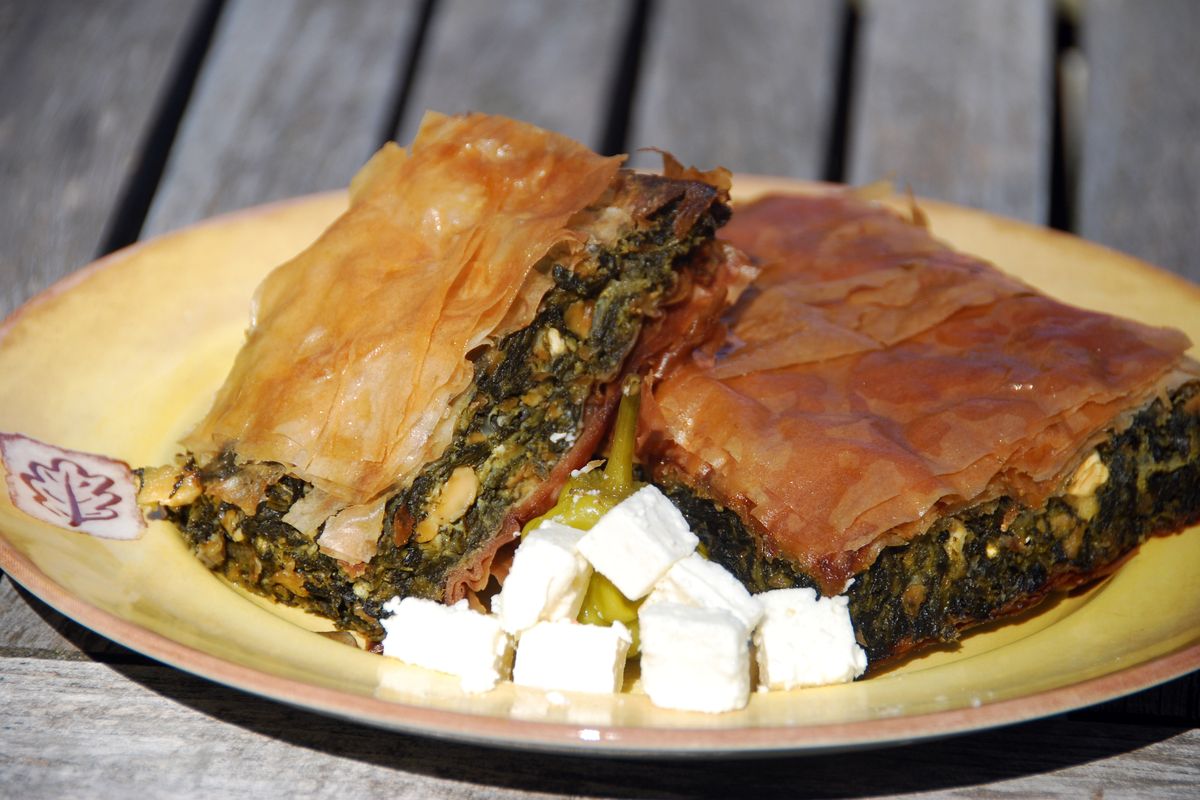
Spanakopita is a Greek savory pie of spinach and cheese wrapped in thin sheets of phyllo. The name joins spanaki, the Greek word for spinach, and pita, meaning pie. The filling usually includes feta. A version with cheese is sometimes called spanakotiropita, or "spinach-cheese pie", a term used especially in northern Greece.
Wikipedia notes that a version without cheese and eggs is eaten during religious fasts across Greece, and that neighbors make their own spinach pies, such as zeljanica in Bosnia and Herzegovina. Phyllo is often linked to Ottoman kitchens. The filo article says the paper-thin form was developed there by the 15th century, but it also calls the earlier origin unclear, so treat any single origin story with care.
This recipe makes the pan version, which suits a home kitchen. Two jobs decide the result: squeezing the spinach nearly dry, and keeping the phyllo from drying out while you work. Get those right and the pie has a crisp, golden top and a firm center that slices cleanly. Sources are listed at the end of this page.
Ingredients and substitutions
Quantities are for 12 pieces.
For the filling
- 30 oz (840 g) frozen chopped spinach, thawed
- 3 tablespoons (45 ml) olive oil
- 1 cup (100 g) scallions, thinly sliced
- ½ cup (15 g) fresh dill, chopped
- ¼ cup (15 g) fresh parsley, chopped
- 2 cups (300 g) feta cheese, crumbled
- 4 large eggs, lightly beaten
- ¼ teaspoon (0.5 g) ground nutmeg
- freshly ground black pepper, to taste
For the pastry
- 1 pound (450 g) phyllo dough, thawed, about 9 x 14 inch (23 x 35 cm) sheets
- ½ cup (115 g) unsalted butter, melted, for brushing
Choosing your ingredients
Frozen chopped spinach is the easiest choice, because it is already cooked and compact. Three 10-ounce (280 g) packages give the amount above. With fresh spinach, start with about 2 pounds (900 g) of leaves, wilt them in a big pot, cool them and squeeze. Either way, it should feel crumbly, not wet.
Phyllo is sold frozen in a flat box. Thaw the unopened box in the refrigerator overnight. Thawing it fast makes the sheets sticky, and they tear. Let the box sit at room temperature for about 30 minutes before you unroll it. Small tears are hidden by the next sheet.
Feta from a block in brine crumbles into creamier pieces than the dry pre-crumbled kind. It is salty, so this filling has no added salt. Taste a crumb before you mix. Wikipedia lists dill, mint and parsley as common herbs, and kefalotiri as a cheese that can be mixed with feta.
Butter browns the top well and tastes rich. Olive oil also works and tastes lighter. Use a metal or glass pan about 9 by 13 inches (23 by 33 cm) and at least 2 inches (5 cm) deep.
Possible substitutions
- Frozen spinach: About 2 pounds (900 g) fresh spinach, wilted, cooled, chopped and squeezed dry.
- Feta cheese: 1 1/2 cups (225 g) feta plus 1/2 cup (120 g) ricotta for a softer, milder filling.
- Dill or parsley: Chopped fresh mint, or more of the other herb. Dried dill is stronger, so use about 1 tablespoon.
- Scallions: 1 small yellow onion or 1 medium leek, chopped and cooked in the olive oil for 5 to 7 minutes until soft.
- Unsalted butter: Olive oil in the same amount, warmed slightly so it brushes easily.
Step-by-step method
- Dry the spinach. Thaw the spinach in a colander. Squeeze it in small handfuls inside a clean kitchen towel, twisting hard, for 3 to 5 minutes in total. Stop when only a few drops come out and the spinach looks like loose, crumbly clumps. Fluff it into a large bowl.
- Soften the scallions and mix the filling. Warm the olive oil in a small pan over medium heat. Cook the scallions for 2 to 3 minutes, until soft and bright but not browned. Add them to the spinach with the herbs, feta, eggs, nutmeg and pepper. Mix until no dry feta clumps remain. Add salt only if the raw mix tastes flat.
- Set up the pan and the phyllo. Heat the oven to 375°F (190°C) with a rack in the middle. Brush the pan lightly with melted butter. Unroll the phyllo, trim the stack to fit the pan, and cover it with a slightly damp towel. Phyllo dries out in minutes, so take out only a few sheets at a time.
- Build the bottom layers. Lay one sheet in the pan, letting the edges climb the sides. Brush it all over with butter, edges first. Add the next sheet and brush again. Repeat until about half the sheets are used, which takes 5 to 8 minutes. The stack should look glossy, with no dry white patches.
- Add the filling and the top layers. Spread the filling in an even layer, pressing it into the corners. Cover it with a sheet of phyllo and brush with butter. Repeat with the remaining sheets, buttering each one. Tuck the overhanging edges down inside the pan, then brush the top generously with the last of the butter.
- Score the top. Use a sharp knife to cut the top layers into 12 squares, cutting about halfway down and no further. Baked phyllo shatters when you cut it, so scoring first gives neat pieces. The cuts also let steam escape. Brush the cuts with a little more butter so the edges brown evenly.
- Bake until deep golden. Bake for 45 to 55 minutes, rotating the pan once after 25 minutes. The top should be deep golden and crisp, and the filling should feel set when you press the center. An instant-read thermometer in the center should read 160°F (71°C). If the top darkens too fast, cover it loosely with foil.
- Rest, then cut and serve. Let the pie rest on a rack for 15 to 20 minutes. The filling firms up as it cools, which gives clean squares. Finish cutting through the scored lines with a serrated knife, using a gentle sawing motion. Serve warm or at room temperature, for no more than 2 hours.
Variations
For triangles, cut the phyllo stack lengthwise into strips about 3 inches (7.5 cm) wide. Brush a strip with butter, put a heaping tablespoon of filling near one end and fold the corner over to form a triangle. Keep folding along the strip like a flag. Bake the buttered triangles on a lined sheet at 375°F (190°C) for 20 to 25 minutes, until deep golden.
A fasting-style version leaves out the eggs and the cheese. According to Wikipedia, it is eaten during Lent and other religious fasts and uses spinach, onions or scallions, herbs such as dill and parsley, and olive oil. Brush the phyllo with olive oil instead of butter. Wikipedia also says rural Greek cooks may add leeks, chard or sorrel for part of the spinach.
Storage and reheating
Refrigerate leftovers within 2 hours of baking, because the filling contains eggs and cheese. Cover the pan tightly or move the squares to an airtight container. They keep for 3 to 4 days. Baked pieces can also be frozen, wrapped well, for up to about 3 months.
Reheat squares on a baking sheet in a 350°F (175°C) oven for 15 to 20 minutes, until the pastry is crisp and the center reaches 165°F (74°C). Frozen pieces need a little longer. A microwave makes the phyllo soft and chewy, so use it only when you are in a hurry.
Common mistakes
- Leaving water in the spinach. Wet spinach releases liquid as the pie bakes and soaks the bottom sheets. Squeeze until it is crumbly, then fluff it before you mix.
- Letting the phyllo dry out. Uncovered sheets turn brittle and crack within minutes. Keep the stack under a damp towel and take out only what the next layer needs.
- Skipping the butter between sheets. Dry layers stick together and bake up pale and chewy instead of flaky. Brush every sheet with a thin coat.
- Not scoring before baking. Cutting through a crisp, fully baked top shatters it and drags the filling around. Score first, then finish cutting after the rest.
Frequently asked questions
Can I make spanakopita ahead of time?
Yes. Assemble the pie, cover it tightly and refrigerate it for up to a day, then bake it straight from cold, adding 5 to 10 minutes. Do not leave the raw pie on the counter.
Is phyllo the same as puff pastry?
No. Phyllo is a paper-thin dough that crisps when each sheet is brushed with fat and layered. Puff pastry is thicker and rises. Wikipedia notes that some cooks do make this pie with puff pastry, but the texture is different.
Why did my phyllo tear?
Usually it was thawed too fast or left uncovered. Thaw it overnight in the refrigerator and keep it under a damp towel. Torn sheets still work in a layered pie.
Can I freeze it before baking?
Yes, wrapped well in the pan for about a month. Bake it straight from the freezer at 350°F (175°C), adding 15 to 20 minutes, and check that the center reaches 160°F (71°C).