Latin America
Pão de Queijo: Brazilian Cheese Bread Rolls
Small Brazilian cheese rolls made with tapioca starch, milk, oil, eggs and cheese: a crisp thin crust, a chewy center, about 50 minutes.
By Lavin Food Editorial · Published
- Prep
- 25 min
- Cook
- 25 min
- Total
- 50 min
- Yield
- 24 rolls
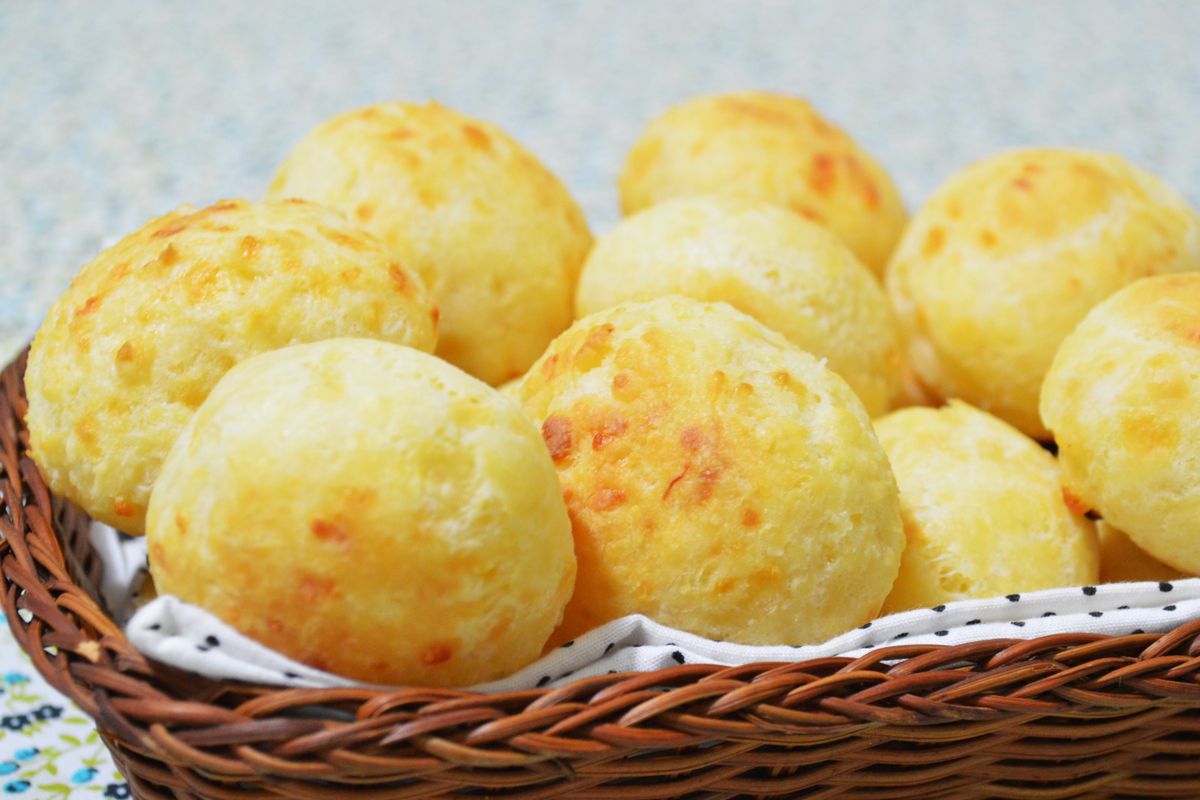
About this dish
Pão de queijo means "cheese bread" in Portuguese. It is a small baked cheese roll, popular in Brazil as a snack and a breakfast food, and Wikipedia describes it as a traditional recipe from the state of Minas Gerais. In Brazil it is cheap and easy to find, sold at street stands, bakeries and supermarkets, fresh or frozen. The texture is the point: a thin, crisp crust around a stretchy, chewy center.
The rolls are not made with wheat. The base is starch from the cassava root, the plant tapioca comes from. According to Wikipedia, cooks in the mining region of southeast Brazil made a bread from cassava starch around the 1700s, when wheat was not available, and grated hard cheese was added in the late 19th century. There is no yeast. The dough rises because small pockets of steam expand in the oven and are held in by the stretchy starch paste.
This version uses the scalded method: hot milk and oil are poured over the starch before the eggs and cheese go in. It works with tapioca starch from an ordinary supermarket. The dough is sticky, shaped with oiled hands, and baked in a hot oven. Expect rolls that puff to nearly double and settle a little as they cool.
Ingredients and substitutions
Quantities are for 24 rolls.
For the dough
- ½ cup (120 ml) whole milk
- ¼ cup (60 ml) neutral oil, such as canola or sunflower, plus a little for your hands
- 1 teaspoon (6 g) fine salt
- 2 cups (250 g) tapioca starch, also sold as tapioca flour or cassava starch
- 2 large eggs
For the cheese
- 1 cup (100 g) Parmesan cheese, finely grated
- ½ cup (50 g) low-moisture mozzarella, shredded
- parchment paper, for lining the baking sheets
Choosing your ingredients
The starch is the heart of the recipe, and the label matters. Look for a bag marked tapioca starch or tapioca flour; in most shops these names mean the same fine white powder. Do not use pearl or instant tapioca, which are beads and will not make a dough. Cornstarch and wheat flour are not substitutes. Wikipedia notes that Brazilian cooks traditionally use both sweet and sour cassava starch (polvilho doce and polvilho azedo).
In plain terms, sweet starch is the neutral one, and it is what most stores carry. Sour starch has a faint tang from an extra fermenting step and is sold by Latin American grocers and online shops. Use the sweet starch alone for a first batch. If you find sour starch, replace half of the amount (1 cup, or 125 g) and compare.
Cheese gives the rolls their name. Wikipedia lists mozzarella, Parmesan and Minas or canastra cheese as the usual choices. Minas cheese is hard to find in many shops, so this version uses Parmesan for sharp, salty flavor and low-moisture mozzarella for stretch. Grate the Parmesan finely so it blends into the dough, and shred your own mozzarella if you can, since bagged shreds carry a dusting of starch.
Use whole milk and a neutral oil. The oil keeps the inside tender, and olive oil is too strong here. Line the sheets with parchment paper, since the cheese can stick and burn on a bare pan.
Possible substitutions
- Tapioca starch: Replace up to half with sour cassava starch (polvilho azedo) for a tangier roll. Cornstarch and flour are not substitutes.
- Parmesan and mozzarella: 1 1/2 cups (150 g) of one cheese, or a mix of aged cheeses such as Pecorino, aged Gouda or sharp white cheddar. Semi-cured Minas cheese, if you find it, can replace the Parmesan.
- Whole milk: 2% milk or unsweetened plain plant milk. The rolls will be a little less rich.
- Neutral oil: The same amount of melted butter. The rolls taste richer but brown faster, so check them a few minutes early.
- Eggs: No good swap. The eggs bind the dough and give it structure.
Step-by-step method
- Heat the oven and prepare the pans. Set a rack in the middle and heat the oven to 400°F (200°C). Line two large baking sheets with parchment paper. Grate the Parmesan finely and shred the mozzarella, then toss them together. Measure the tapioca starch into a large heatproof bowl. This takes about 10 minutes, and the dough comes together fast once the milk is hot.
- Scald the starch. Combine the milk, oil and salt in a small saucepan and bring to a full boil over medium-high heat, 2 to 4 minutes. Pour it at once over the starch. Stir hard with a sturdy spatula for about 1 minute, until no dry starch is left and the mixture looks like a thick, translucent, sticky paste with some lumps.
- Cool the dough. Leave the bowl alone for 8 to 10 minutes, stirring once or twice. The dough should stop steaming and feel comfortably warm to a quick touch, not hot. If it is too hot, the eggs will cook into bits when they go in. Cooling also lets the starch absorb the liquid evenly.
- Beat in the eggs and cheese. Add one egg and mix hard with the spatula, or on low speed in a stand mixer with the paddle, for 1 to 2 minutes. The paste looks split at first, then turns smooth and glossy. Add the second egg the same way, then stir in all the cheese. The dough should be soft, tacky and thick, like heavy cookie dough.
- Adjust the dough if needed. Roll a small piece in oiled hands. If it will not hold a ball and slumps flat, stir 1 to 2 tablespoons of tapioca starch into the dough. If it feels stiff and cracks, stir in 1 tablespoon of milk. Do this before shaping, because different brands of starch absorb liquid a little differently.
- Shape the rolls. Rub a little oil on your palms. Pinch off pieces of dough about the size of a walnut, roughly 1 ounce (28 g), and roll them into smooth balls about 1 1/4 inches (3 cm) across. Set them 2 inches (5 cm) apart on the pans. Re-oil your hands whenever the dough sticks. You should get about 24 rolls in around 10 minutes.
- Bake until puffed and golden. Bake for 20 to 25 minutes, swapping the pans between racks and turning them halfway through. The rolls are done when they have puffed to nearly double, feel light and have a pale golden crust with darker spots from the cheese. Do not open the door in the first 15 minutes, since a drop in heat can make them sink.
- Cool briefly and serve. Let the rolls sit on the pan for 5 minutes. They settle a little and the crust crisps as the steam escapes. Serve warm, within about 20 minutes, while the outside is crisp and the center is stretchy. Break one open to check: the inside should be damp and chewy with air pockets, not gummy.
Variations
Wikipedia notes that stuffed versions are common in Brazil, filled with soft cheeses such as catupiry or requeijão, or with sweet fillings like guava paste. Flatten a ball of dough in your palm, press a small cube of cheese into the center and seal it. Make these rolls slightly larger and bake them 2 to 3 minutes longer.
For a savory change, add 2 tablespoons of chopped chives to the dough. For a milder roll, use more mozzarella and less Parmesan. Larger balls, about 2 inches (5 cm), need 5 to 8 more minutes in the oven.
Storage and reheating
Baked rolls are best the day they are made. Cool them completely, then refrigerate in an airtight container within 2 hours of baking, for up to 3 to 4 days. Reheat on a baking sheet in a 350°F (175°C) oven for 8 to 10 minutes to bring back the crisp crust. A microwave makes them soft and rubbery.
The shaped raw balls freeze well, which is the easiest way to have fresh rolls on short notice. Freeze them on a lined sheet until firm, about 1 hour, then move them to a freezer bag for up to 3 months for best quality. Bake straight from frozen at 400°F (200°C) for 25 to 30 minutes. The dough contains raw egg, so wash your hands after handling it and do not eat it raw.
Common mistakes
- Using the wrong starch. Pearl tapioca, cornstarch and flour do not behave like cassava starch. Buy a fine powder labeled tapioca starch, tapioca flour or cassava starch.
- Adding the eggs to hot dough. Hot dough cooks the eggs into small white flecks and the rolls turn dense. Wait until the dough is warm to the touch, about 8 to 10 minutes after scalding.
- Pouring lukewarm liquid over the starch. The milk and oil must be at a full boil. Weak heat leaves the starch partly raw, and the rolls come out dry and crumbly instead of chewy.
- Opening the oven too early. The rolls rise from trapped steam. Opening the door in the first 15 minutes cools the oven, and the puffed balls can sink.
- Baking until deep brown. These rolls are pale and light. Pulling them when golden keeps the inside chewy, while overbaking dries them into hard, hollow shells.
Frequently asked questions
Are pão de queijo gluten-free?
The recipe has no wheat, and cassava starch contains no gluten, so the plain rolls are naturally gluten-free as written. Cross-contact is a separate question. Check the labels on the starch and cheese, and use clean pans if you need to avoid gluten strictly.
Why are my rolls flat?
The usual causes are a dough that was too loose, eggs added while the dough was hot, or an oven that was not fully heated. Test a ball first, and add a spoonful of starch if it slumps. Heat the oven for at least 15 minutes before baking.
Can I make the dough ahead?
Yes. Shape the balls and freeze them, then bake from frozen. Dough left in the refrigerator firms up and is harder to shape, so freezing is the better way to plan ahead.
Can I make them in a blender?
Many modern recipes blend a looser, unscalded batter and bake it in a mini muffin pan. That is a different method with a puffier, lighter result. This page covers the scalded, hand-shaped dough.