European Classics & Core Techniques
Béchamel Sauce: The Classic White Sauce, Step by Step
A smooth white sauce of butter, flour and warm milk with nutmeg, with ratios for thin, medium and thick versions. Ready in about 30 minutes.
By Lavin Food Editorial · Published
- Prep
- 10 min
- Cook
- 20 min
- Total
- 30 min
- Yield
- 4 servings
About this dish
Béchamel sauce is a white sauce made from a roux of butter and flour, heated with milk or cream and seasoned with ground nutmeg. It is often called simply white sauce. Wikipedia lists it among the mother sauces of French cuisine, which are base sauces that many other sauces are built on. Add cheese and it becomes Mornay.
Its history is only partly settled. A sauce similar to béchamel, made with a roux, appears in a 1651 book by François Pierre de La Varenne, and the first sauce actually named béchamel appears in Vincent La Chapelle's The Modern Cook of 1733. The name is thought to come from Louis de Béchameil, a financier who served King Louis XIV, but that link is a belief rather than proof. A popular story says the sauce came from Tuscany with Catherine de Medici, but Wikipedia notes that archival research does not support it. The list of mother sauces has also changed over time: Carême named béchamel among four grand sauces in 1833.
This page teaches the method. You get a medium-thick sauce for gratins and lasagna, plus ratios for thinner and thicker versions. The goal is a pale, glossy sauce with no hint of raw flour.
Ingredients and substitutions
Quantities are for 4 servings.
For the sauce
- 4 tablespoons (55 g) unsalted butter
- 4 tablespoons (30 g) all-purpose flour
- 2 cups (480 ml) whole milk, warmed
- ½ small (40 g) yellow onion, peeled and halved, optional
- 1 leaf bay leaf, optional
- ½ teaspoon (3 g) fine salt
- ⅛ teaspoon (0.3 g) white pepper, ground
- ¼ teaspoon (0.5 g) nutmeg, freshly grated
To turn it into Mornay (optional)
- 1 cup (100 g) grated Gruyère or sharp cheddar
Choosing your ingredients
Whole milk gives the creamiest sauce. Two percent milk works but tastes thinner. Warm the milk until it steams. Cold milk also works, but it seizes the roux into clumps more easily, while warm milk blends in smoothly.
Thickness depends only on the ratio of roux to milk. For each cup (240 ml) of milk, use 1 tablespoon (14 g) butter and 1 tablespoon (8 g) flour for a thin sauce, which suits soups. Use 2 tablespoons (28 g) butter and 2 tablespoons (15 g) flour for a medium sauce, which suits gratins, lasagna and Mornay. Use 4 tablespoons (57 g) butter and 4 tablespoons (30 g) flour for a thick sauce, which holds the shape of croquettes. The recipe below is medium, scaled to 2 cups (480 ml).
A roux is flour cooked in fat, here butter. For béchamel it is a white roux, cooked just long enough to lose the raw flour taste, with little or no color. Use unsalted butter so you control the salt. Level the flour in the spoon, because packed flour makes the sauce gluey.
Freshly grated nutmeg has far more aroma than the pre-ground kind. White pepper keeps the sauce free of dark specks. Wikipedia mentions onion, nutmeg and thyme as typical flavorings. Use a heavy 2-quart (2 L) saucepan, which resists scorching, and a whisk.
Possible substitutions
- Whole milk: Two percent milk for a lighter sauce, or half milk and half cream for a richer one. Plain unsweetened oat or soy milk also works, with a different taste.
- Unsalted butter: Salted butter, with the added salt cut to a pinch.
- All-purpose flour: A 1-to-1 gluten-free flour blend. Simmer a few minutes longer and expect a slightly grainier texture.
- White pepper: Fine black pepper. The sauce will show small dark flecks.
- Fresh nutmeg: Pre-ground nutmeg in the same amount, added at the very end because its aroma fades.
- Onion and bay leaf: Leave both out. A plain sauce is still correct.
Step-by-step method
- Warm the milk. Pour the milk into a small saucepan and add the onion half and bay leaf. Heat over medium-low for 3 to 4 minutes, until the milk steams and small bubbles form at the edge. Do not let it boil. Set it aside and measure the flour into a small bowl.
- Melt the butter. In a heavy 2-quart (2 L) saucepan, melt the butter over medium-low heat. This takes 1 to 2 minutes. The butter should be fully liquid and foam gently. If it turns tan, lower the heat.
- Cook the roux. Add all the flour at once and whisk constantly for 1 to 2 minutes. The mixture will turn into a thick, bubbly paste that smells faintly of warm biscuits instead of raw flour. It should stay pale cream. If it starts to color, lift the pan off the heat.
- Add the first milk. Take the pan off the heat. Pour in about a quarter of the warm milk and whisk hard for 30 to 60 seconds. The roux will seize into a very thick paste at first, then loosen into a smooth, glossy cream. Reach into the corners of the pan.
- Whisk in the rest of the milk. Add the remaining milk in three or four pours, whisking until smooth after each one. This takes 2 to 3 minutes in all. Return the pan to medium-low heat once all the milk is in. The sauce is still thin and pourable now.
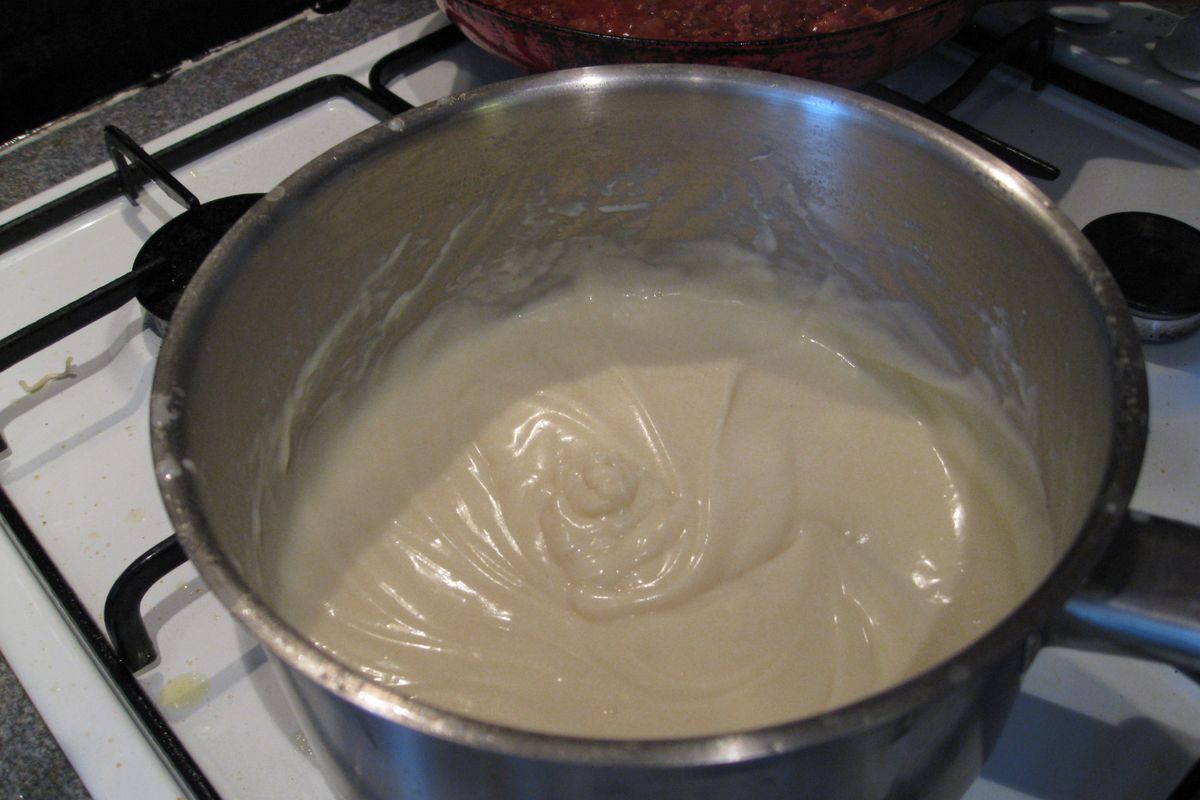
- Simmer until thick. Cook at a gentle simmer for 8 to 10 minutes, whisking often and scraping the corners. The sauce is ready when it thickens, turns glossy and coats the back of a spoon. Draw a finger across the spoon; the line should hold. Taste it. Any raw flour taste means a few more minutes.
- Season and strain. Remove the onion and bay leaf. Off the heat, stir in the salt, white pepper and nutmeg, then taste and adjust. If you see any lumps, pour the sauce through a fine mesh strainer. To hold it for later, press plastic wrap directly onto the surface, or dab on a little butter, so no skin forms.
Variations
For Mornay, take the hot sauce off the heat and stir in 1 cup (100 g) of grated Gruyère or sharp cheddar until melted and smooth. Mornay is the base of a stovetop mac and cheese: toss it with 8 ounces (225 g) of cooked macaroni. It also tops a croque monsieur, a ham and cheese sandwich, which is broiled for 3 to 5 minutes until the sauce bubbles and browns.
For lasagna, layer medium béchamel with the meat sauce and pasta and bake at 375°F (190°C) for 35 to 45 minutes, until the edges bubble and the top is golden. Use the thin ratio for a creamy soup base, and the thick ratio for croquettes, where the sauce binds the filling and is chilled until firm enough to shape.
Storage and reheating
Cool the sauce quickly and refrigerate it within two hours of cooking. Press plastic wrap onto the surface, then store in an airtight container for 3 to 4 days. You can freeze it for about 3 months. It may look grainy after thawing; whisk it over low heat to bring it back.
Cold béchamel sets as firm as pudding. To reheat, warm it in a saucepan over low heat with a splash of milk, whisking until smooth, or microwave in 30-second bursts, stirring each time. Heat leftovers until steaming hot all the way through, to 165°F (74°C).
Common mistakes
- Adding all the milk at once. A big pour of liquid onto the roux makes clumps that are hard to break. Add the milk in stages and whisk smooth between each.
- Browning the roux. A roux that takes on color changes the flavor and the look of the sauce. Keep the heat at medium-low and stop at pale cream, after 1 to 2 minutes.
- Skipping the simmer. Sauce that has not simmered for 8 to 10 minutes can taste of raw flour and stay thin.
- Walking away from the pan. Milk sauces catch and scorch on the bottom. Whisk often, scrape the corners and keep the heat low.
- Judging thickness too soon. The sauce thickens as it cools. Stop when it coats a spoon.
Frequently asked questions
How do I fix a lumpy béchamel?
Whisk hard first, off the heat, as small lumps often dissolve. If they stay, pour the sauce through a fine mesh strainer. Do not blend hot sauce in a closed blender jar, because the steam can push off the lid.
How do I stop a skin from forming?
Press plastic wrap directly onto the surface of the sauce, or dab a little butter on top and let it melt into a thin film. Either one blocks the air that causes a skin.
Can I make it ahead?
Yes. Cover the surface, cool it within two hours and refrigerate for up to 3 or 4 days. Reheat gently, as described under storage.
Is béchamel the same as white sauce?
Mostly yes. Wikipedia says béchamel is also called white sauce in some places. Recipes called white sauce may skip the nutmeg or the simmer, but the roux-and-milk method is the same.