European Classics & Core Techniques
French Omelet: Soft, Pale and Rolled
A soft, pale, unbrowned omelet made with three eggs and butter in an 8-inch pan, stirred, rolled onto the plate and done in about 3 minutes.
By Lavin Food Editorial · Published
- Prep
- 5 min
- Cook
- 3 min
- Total
- 8 min
- Yield
- 1 omelet
About this dish
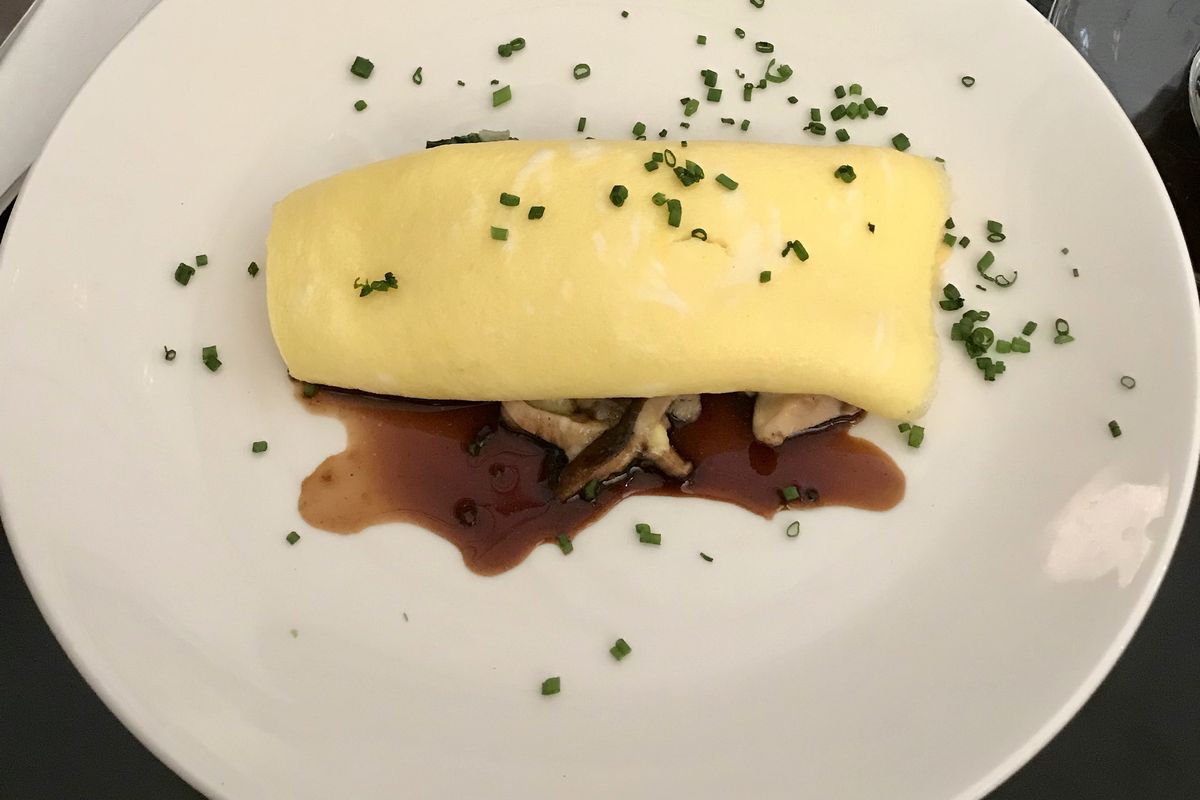
A French omelet is a smooth, pale, softly set omelet rolled into a plump cylinder. Wikipedia notes that some cookbooks, reflecting high-end restaurant practice, describe it as unbrowned and cooked slowly over medium-low to medium heat, with stirring at the start so the eggs form small curds and do not stick. It is seasoned with little more than salt and pepper and is often flavored with finely chopped herbs.
Sources do not agree on one definition. Wikipedia says that, depending on the source, a standard omelette in France may be golden brown or unbrowned, so the pale version here is one accepted style, not the only one. Omelettes are believed to have started in ancient Persia. Nothing we read settles who first made the pale, rolled style, so this page names no inventor and no date.
This version uses three eggs, butter and an 8-inch (20 cm) pan, and it is done in about three minutes. It is a technique more than a recipe: you stir, you shake, you stop at the right moment and you roll. The filling is optional. The eggs are the point.
Ingredients and substitutions
Quantities are for 1 omelet.
For the omelet
- 3 large eggs
- ⅛ teaspoon (1 g) fine salt
- 1 teaspoon (5 ml) cold water, optional
- freshly ground black pepper, a small pinch, or white pepper
- 1 tablespoon (14 g) unsalted butter, for the pan
To finish
- 1 teaspoon (5 g) unsalted butter, cold, for the top
- 1 tablespoon (3 g) fresh chives, finely chopped
- toast or a green salad, for serving, optional
Choosing your ingredients
Start with fresh eggs from the refrigerator. Three large eggs fill an 8-inch (20 cm) pan to a depth that cooks in about two minutes. Whisk them well, because a streak of clear white left in the bowl becomes a rubbery patch in the omelet.
Unsalted butter lets you control the salt. Cook it only until it melts and foams. Brown butter tastes nutty, but it tints the eggs tan, and a pale surface is the goal. A teaspoon of water is optional. Wikipedia notes that whole eggs are often beaten with a little milk, cream or water, and water adds steam that keeps the texture tender.
The pan matters more than any other tool. Use an 8-inch nonstick skillet with sloping sides, or a well-seasoned carbon steel pan. In a nonstick pan, use a silicone or nylon spatula, and never heat the empty pan on high. Check the maker's guidance, because many coatings are not meant for high heat.
Chives are the simplest herb finish. Cut them with a sharp knife or scissors so they stay clean, not bruised.
Possible substitutions
- Unsalted butter: Salted butter, and leave out the salt in the eggs. Clarified butter or ghee also works and is less likely to brown.
- Cold water: The same amount of milk or cream for a slightly richer result, or leave it out.
- Chives: Finely chopped parsley, or a fines herbes mix, about 1 tablespoon (4 g) in total.
- Chervil: Fresh basil. Wikipedia notes that the chef Pierre Franey used basil in place of chervil in a recipe for home cooks.
- 8-inch nonstick pan: A well-seasoned carbon steel or cast-iron pan of the same size, with a little extra butter.
- Black pepper: White pepper, which leaves no dark flecks on the surface.
Step-by-step method
- Set up and whisk the eggs. Put a warm plate, a silicone spatula and the chopped chives by the stove, because the cooking takes only about 3 minutes. Crack the eggs into a bowl and add the salt, water and pepper. Whisk with a fork for 30 to 45 seconds, until no clear white remains and the mixture looks pale yellow and slightly frothy.
- Melt the butter. Set the 8-inch (20 cm) pan over medium heat and add the 1 tablespoon of butter. Swirl for 30 to 60 seconds, until it melts and the foam rises, then starts to settle. The butter should smell sweet, not nutty. If you see brown specks, wipe the pan and start again, since brown butter tints the eggs.
- Pour, stir and shake. Pour in all the eggs at once. Right away, stir with the spatula in small, quick circles while you shake the pan back and forth with the other hand. Keep going for 20 to 30 seconds, until small soft curds float in a creamy layer of loose egg. It should look like very wet scrambled eggs.
- Smooth and set the base. Stop stirring. Shake the pan flat so the eggs spread into an even layer. Lower the heat if the edges puff or turn gold. Leave the omelet alone for 15 to 30 seconds, until the bottom is just set and the top is still glossy and wet-looking, but no longer runs when you tilt the pan.
- Fold and roll. Tilt the pan away from you at about 45 degrees. Use the spatula to fold the edge nearest the handle over the center, then tap the handle with the heel of your other fist so the omelet rolls toward the far edge. This takes 10 to 15 seconds. You want a plump cylinder, seam down, with no brown on the skin.
- Roll it out onto the plate. Hold the warm plate right against the lip of the pan. Turn the pan over the plate in one smooth move, so the omelet rolls out seam-down. Tuck in the ends with the spatula. This takes 5 to 10 seconds. The skin should look smooth and pale yellow with a soft shine. A small tear is fine.
- Finish with butter and chives. Rub the cold teaspoon of butter over the hot omelet. It melts in 5 to 10 seconds and gives a glossy finish. Scatter the chives on top and serve right away. When you cut it open, the center should be soft and creamy, set at the edges, not runny with liquid egg.
Variations
For an omelette aux fines herbes, whisk about 1 tablespoon (4 g) of chopped parsley, chives, tarragon and chervil into the eggs. Wikipedia cites the chef Auguste Escoffier, who wrote in 1903 that an omelette with this name should hold more than parsley alone. Sources differ on the exact mix, so treat the list as a guide. For a cheese version, sprinkle about 1/4 cup (25 g) of finely grated Gruyere over the eggs just before you roll.
To add a filling, cook it separately, keep it warm and spoon it in a line down the center just before you roll. Not every French omelet is rolled: Wikipedia calls the Provencal omelette closer to a frittata.
Storage and reheating
A French omelet is made to be eaten the moment it leaves the pan. Do not whisk the eggs ahead and leave them out. Raw egg mixture left at room temperature for more than two hours (one hour above 90°F or 32°C) should be thrown away.
Refrigerate leftover omelet within two hours, in a covered container, for 3 to 4 days. Reheat until steaming hot, to 165°F (74°C), which sets the center and ends the creamy texture. Freezing is not recommended, because cooked eggs turn rubbery and watery.
Common mistakes
- Using high heat. High heat browns the underside and makes the eggs tough. Stay at medium, and lift the pan off the burner if the eggs set too fast.
- Skipping the whisking. Streaks of white cook differently from yolk and leave rubbery patches. Whisk until the mixture is uniform and pale.
- Using a pan that is too big. In a 12-inch pan, three eggs make a thin sheet that overcooks before you can roll it. Keep to 8 inches (20 cm).
- Stirring for too long. Stir only until small soft curds appear, about 20 to 30 seconds. Longer, and it turns into scrambled eggs that will not roll.
- Using metal tools on nonstick. Metal scratches the coating. Use silicone or nylon.
Frequently asked questions
How is it different from a browned, folded omelet?
The sources we read do not define one standard folded style, so this answer stays narrow. Wikipedia describes the French style as unbrowned and stirred at first, and it lists folded, filled examples such as the Denver omelette, filled with diced ham, onion and green pepper. The French style here is pale, soft and rolled, with the filling optional.
Is a soft-set omelet safe to eat?
A soft-set omelet is not fully cooked, so it carries a small risk of foodborne illness. Young children, older adults, pregnant people and anyone with a weakened immune system should eat eggs cooked until both white and yolk are firm. The USDA advises cooking egg dishes to 160°F (71°C). For these groups, cook the omelet longer over medium-low heat, until no liquid egg is visible.
Do I need a nonstick pan?
No, but it is the easiest choice. A smooth, well-seasoned carbon steel pan also works, with a little extra butter. Stainless steel tends to stick.
Can I use two or four eggs?
Yes. Use a 6-inch (15 cm) pan for two eggs and a 10-inch (25 cm) pan for four. Keep the layer of egg about the same depth so it rolls cleanly.