Mediterranean
Spanish Tortilla: Potato and Onion Omelet
A thick Spanish omelet of potatoes and onion slowly cooked in olive oil, bound with eggs and flipped on a plate. About 1 hour.
By Lavin Food Editorial · Published
- Prep
- 20 min
- Cook
- 40 min
- Total
- 1 hr
- Yield
- 6 servings
About this dish
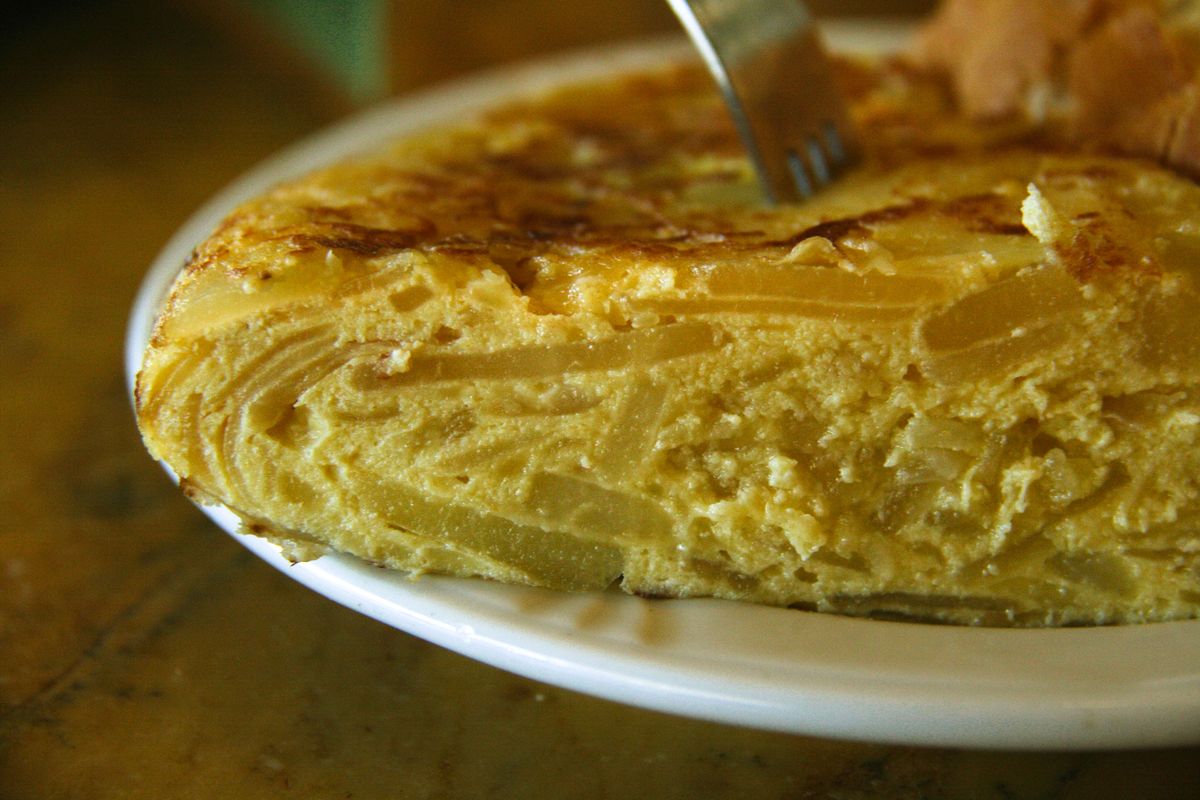
A Spanish tortilla, also called tortilla de patatas or tortilla española, is a thick omelet made with eggs and potatoes, often with onion. In Spain the word tortilla means an omelet, so it has nothing to do with the flat wheat or corn bread of Mexico. The names "Spanish omelet" and "Spanish tortilla" are common partly to keep the two apart. It is cut into wedges for a meal or into small squares for a tapa, and it is often served at room temperature.
Its history is not settled. The first known mention of a tortilla in Spanish is said to appear in a Navarrese document from 1817, which describes thick tortillas stretched with potatoes, breadcrumbs or whatever was at hand. One popular story credits General Tomás de Zumalacárregui with inventing it during the siege of Bilbao in 1835, and another links it to Spanish prisoners returning from Portugal in the 1660s. Wikipedia notes that neither story is confirmed. Even the onion is a point of debate: cooks who add it are called concebollistas, and those who refuse it are sincebollistas.
This version uses the common method. The potatoes and onion are simmered, not fried, in plenty of olive oil until soft but not brown. They are drained, mixed with beaten eggs, and cooked in a skillet. When one side is set, the pan is inverted onto a plate to turn the tortilla over. The center can stay juicy or be cooked fully firm.
Ingredients and substitutions
Quantities are for 6 servings.
For the tortilla
- 1½ pounds (680 g) waxy or all-purpose potatoes, such as Yukon Gold, peeled
- 1 medium (150 g) yellow onion, thinly sliced
- ¾ cup (180 ml) olive oil, for poaching the potatoes
- 1½ teaspoons (9 g) fine salt
- 6 large eggs
- 1 tablespoon (15 ml) reserved cooking oil, strained from the pan, for cooking the tortilla
To serve
- crusty bread, optional
- roasted red peppers or tomato salad, optional side
Choosing your ingredients
The potato sets the texture. Waxy or all-purpose potatoes such as Yukon Gold hold together and turn creamy. Floury russets give a softer, more crumbly filling. Slice about 1/8 inch (3 mm) thick, or dice small, so the pieces cook at the same speed.
Olive oil does the cooking here, so use one you like the taste of. The potatoes should sit in a shallow pool of oil, not a thin film. Most of the oil is strained out afterward, and the strained oil can be reused once it has cooled.
Potatoes need more salt than most cooks expect. Salt them as they cook, then taste the egg mixture before it goes in the pan.
Use a nonstick or well-seasoned skillet about 10 inches (25 cm) across, with sloped sides, and a flat plate slightly wider than the pan. A sticky pan is the most common reason a tortilla tears when it is flipped.
Possible substitutions
- Yellow onion: Leave it out for a plain potato tortilla, or use a sweet onion for a milder, sweeter taste. Spring onions also work.
- Yukon Gold potatoes: Any waxy or all-purpose potato. Russets work too, but the tortilla will be softer and may break more easily.
- Olive oil: A mild vegetable oil can replace part of it. The taste will be lighter and less fruity.
- Roasted red peppers: Sliced tomato with olive oil and salt, or a simple green salad, for a fresh contrast.
Step-by-step method
- Slice the potatoes and onion. Peel the potatoes and cut them into thin slices, about 1/8 inch (3 mm), or into small dice. Slice the onion thinly. Toss both with the salt in a large bowl. Pat the potatoes dry with a towel if they feel wet, because water makes the hot oil spatter.
- Poach in olive oil. Warm the olive oil in a 10-inch (25 cm) skillet over medium-low heat. Add the potatoes and onion. The oil should bubble gently and never sizzle hard. Cook for 20 to 25 minutes, turning every few minutes, until a potato slice breaks easily under a spoon and nothing has browned. Lower the heat if the edges start to color.
- Drain and cool slightly. Set a strainer over a heatproof bowl and pour in the potatoes and oil. Let them drain for 5 minutes. The oil is very hot, so pour carefully and keep it away from water. Leave the strained oil in the bowl to cool, and wipe out the skillet.
- Combine with the eggs. Beat the eggs in a large bowl with a fork until the yolks and whites are fully blended and no streaks remain. Add the warm potatoes and onion and press them down gently so they are coated. Let the mixture sit for 10 minutes. The potatoes soak up some egg, which gives a creamier, more cohesive tortilla.
- Cook the first side. Heat the reserved cooking oil in the clean skillet over medium heat until it shimmers. Pour in the mixture and spread it flat. Cook for 4 to 6 minutes, shaking the pan now and then, until the edges are firm and the underside is golden. Run a spatula around the edge to loosen it, and check that the tortilla slides when you shake the pan.
- Flip with a plate. Set a flat plate over the pan. Holding the plate firmly with one hand and the pan handle with the other, turn the pan over in one smooth motion, ideally over the sink. Slide the tortilla back into the pan, golden side up, and tuck the edges in with a spatula.
- Finish the second side. For a juicy center, cook for 2 to 3 minutes. The edges should be firm and the middle should still wobble a little. For a fully set tortilla, cook for 5 to 7 minutes over medium-low heat, until no liquid egg shows at the center when you press it lightly. Slide it onto a clean plate.
- Rest before cutting. Let the tortilla stand for at least 10 minutes. The center firms up as it cools and the slices hold together instead of running. Cut into wedges or small squares. It tastes good warm or at room temperature. Do not leave it out for more than 2 hours.
Variations
Cooks often change the base recipe. Some add chorizo, ham or cooked peppers to the egg mixture, and Wikipedia notes that in Galicia it is sometimes made with Galician chorizo. Whatever you add, cook it first and keep it dry, since extra moisture makes the center wet.
For a simple lunch, put a thick wedge inside a crusty roll, with a smear of tomato if you like. For a party, cut a cooled tortilla into small squares and serve each on a slice of bread with a toothpick.
Storage and reheating
Refrigerate the tortilla within 2 hours of cooking, wrapped well or in an airtight container, and eat it within 3 to 4 days. Let the strained oil cool fully before it goes into a covered jar.
To reheat, warm slices in a 325°F (160°C) oven until hot through, to 165°F (74°C), or eat them cold. A tortilla served at room temperature should not sit out for more than 2 hours.
Common mistakes
- Frying instead of poaching. If the oil is too hot, the potatoes brown and turn crisp, and the tortilla tastes harder and drier. Keep the heat low, so the oil only bubbles gently.
- Skipping the rest. A tortilla cut straight from the pan can run and fall apart. Resting for 10 minutes lets the egg finish setting.
- Using the wrong pan. A scratched or sticky pan tears the tortilla when you flip it. Use a nonstick or well-seasoned pan with sloped sides, and loosen the edges before flipping.
- Slicing unevenly. Thick and thin pieces cook at different speeds, so some stay firm while others fall apart. Keep the slices even.
Frequently asked questions
Should the center be runny or fully set?
Both are traditional, and it is a matter of taste. A juicy center is soft and slightly wet. A fully set tortilla is firm all the way through and holds its shape in a sandwich. The steps give times for both.
Is a juicy tortilla safe to eat?
A partly set center carries a small risk of foodborne illness from raw egg. Young children, older adults, pregnant people and anyone with a weakened immune system should eat a fully set tortilla. Cook it until no liquid egg remains and the center reaches 160°F (71°C).
Does the tortilla have to include onion?
No. Some Spanish cooks always use onion, and others never do. Without it, the flavor is plainer and more potato-forward.
Why does my tortilla stick to the pan?
The pan may be scratched, or the oil may not have been hot enough when the mixture went in. Heat the reserved oil until it shimmers, and loosen the edge before you flip.