Mediterranean
Chicken Paella with Saffron and Green Beans
A home-style chicken paella in a wide skillet: saffron rice, tomato sofrito, green beans and a crisp toasted bottom, ready in about 75 minutes.
By Lavin Food Editorial · Published
- Prep
- 25 min
- Cook
- 50 min
- Total
- 1 hr 15 min
- Yield
- 4 servings
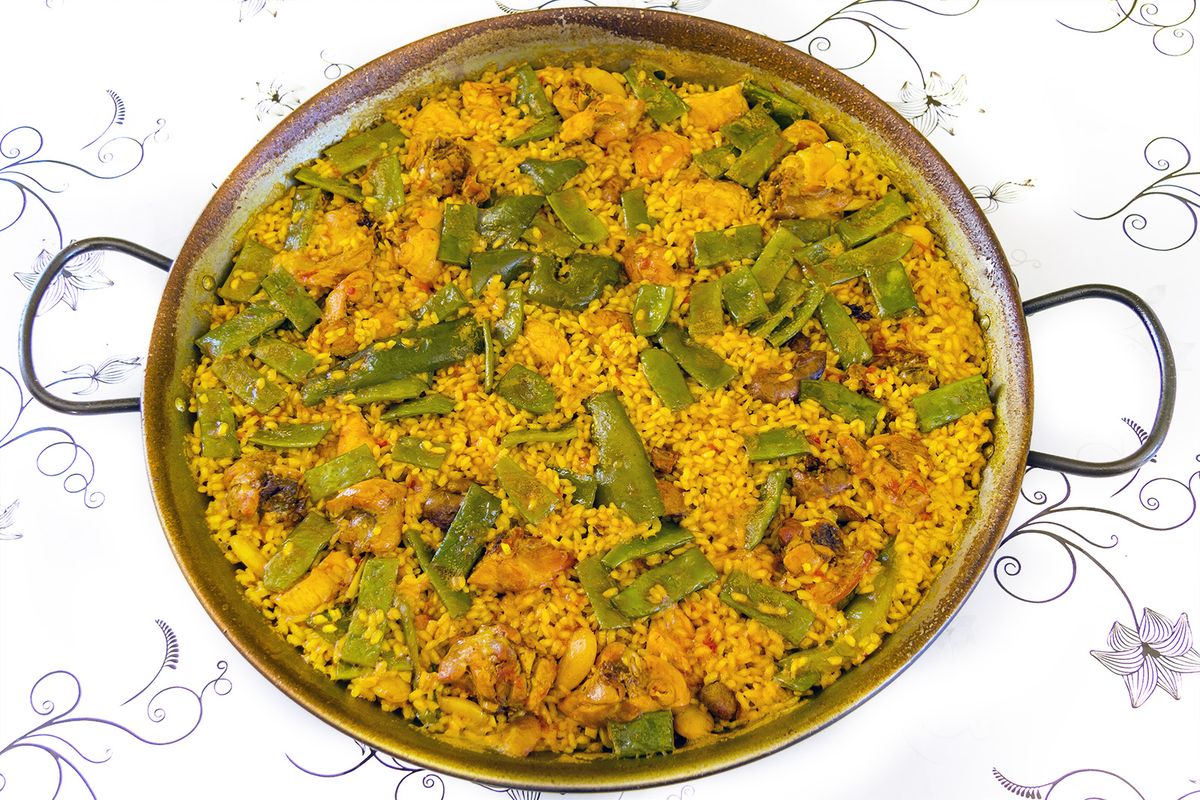
About this dish
Paella is a rice dish from the Valencian Community in Spain, regarded there as one of the region's identifying symbols. The name comes from the wide, shallow pan used to cook it, since paella is the word for a frying pan in Valencian and Catalan. In its modern form the dish is traced to the mid-19th century, in the rural area around the Albufera lagoon next to Valencia.
The Valencian original is a specific dish, and this recipe is not it. According to Wikipedia, paella valenciana is made with Valencian rice, olive oil, rabbit, chicken, duck, snails, saffron or a substitute, tomato, flat green beans, lima beans, salt and water. Many Valencians say only that version is the true paella, and sources describe disputes over additions such as chorizo and seafood. This page is a home-style version: chicken thighs only, plus red bell pepper and smoked paprika, with stock instead of water.
What it keeps is the method: a sofrito (a slow-cooked base of tomato and garlic), saffron stock, and short-grain rice cooked in a thin layer without stirring.
Ingredients and substitutions
Quantities are for 4 servings.
For the chicken and sofrito
- 4 tablespoons (60 ml) olive oil
- 2 pounds (900 g) bone-in, skin-on chicken thighs, trimmed of excess fat
- 1½ teaspoons (9 g) fine salt, divided
- 8 oz (225 g) green beans, trimmed and cut into 2-inch (5 cm) pieces
- 1 medium (150 g) red bell pepper, cut into thin strips
- 4 cloves garlic, minced
- 2 medium (300 g) ripe tomatoes, halved and grated, skins discarded
- 2 teaspoons (5 g) sweet paprika
- ½ teaspoon (1 g) smoked paprika
For the rice
- 3½ cups (840 ml) chicken stock, low-sodium, hot
- ¼ teaspoon (0.1 g) saffron threads
- 1½ cups (300 g) bomba rice, or another short-grain rice, not rinsed
- 1 cup (170 g) cooked lima beans, drained, optional
- 1 sprig fresh rosemary, optional
- ½ cup (120 ml) hot water, only if the rice is still firm
- 1 medium lemon, cut into wedges, for serving
Choosing your ingredients
Bomba is a short-grain rice grown mainly in eastern Spain and commonly used for paella. Wikipedia notes that its amylopectin content is relatively low, so it does not turn sticky or thicken the cooking liquid the way Arborio does. Calasparra, another Spanish short-grain rice, is also a common choice. Arborio works, but it releases more starch, so the result is creamier. Do not rinse the rice.
Use bone-in, skin-on thighs. The bones and skin flavor the stock, and thighs stay juicy through a long cook, while breast meat dries out. The chicken must reach at least 165°F (74°C) at its thickest part, measured without touching the bone.
Saffron gives the rice its color and a floral scent. The smoked paprika is a small home-cook addition and is not part of the Valencian recipe, so keep it at half a teaspoon.
Choose a wide, shallow skillet of 12 to 13 inches (30 to 33 cm) in stainless steel, carbon steel or cast iron. The rice must sit in a thin layer to cook evenly and toast at the bottom. If the pan is wider than your burner, turn it a quarter turn every few minutes.
Possible substitutions
- Bomba rice: Arborio or Calrose. For Arborio, start with about half a cup (120 ml) less stock and expect a softer, creamier result. Avoid long-grain rice such as basmati.
- Saffron threads: A quarter teaspoon of ground turmeric colors the rice, but the flavor will be different.
- Chicken stock: Water, which the Valencian recipe uses. Add a little more salt.
- Ripe tomatoes: 1 cup (240 g) canned crushed tomatoes. Cook the sofrito a couple of minutes longer.
- Lima beans: Drained canned butter beans or cannellini beans, or leave them out.
- Green beans: Flat Romano beans, or thawed frozen cut green beans added in the last 10 minutes.
Step-by-step method
- Steep the saffron in hot stock. Heat the stock in a saucepan until steaming but not boiling. Crush the saffron between your fingers into the stock and add half of the salt. Keep it on the lowest heat for at least 10 minutes. The liquid should turn deep orange. Hot stock keeps the rice cooking steadily later.
- Brown the chicken. Heat the oil in a 12 to 13-inch (30 to 33 cm) skillet over medium-high heat. Season the chicken with the rest of the salt and lay it skin side down in one layer. Cook for 10 to 12 minutes, turning once, until the skin is deep golden. Move it to a plate and leave the oil in the pan.
- Cook the beans and pepper. Lower the heat to medium. Add the green beans and bell pepper to the oil and cook for 4 to 5 minutes, stirring often. The beans should turn bright green and the pepper should soften. Push them to the sides of the pan.
- Build the sofrito. Add the garlic and cook for 30 seconds. Stir in the grated tomato and both paprikas, then cook for 8 to 10 minutes, stirring often. It is ready when it has thickened to a jam, darkened to brick red, and oil shines at the edges.
- Add the stock and chicken. Pour in the saffron stock and bring it to a boil. Return the chicken and vegetables to the pan, add the rosemary and simmer for 3 to 4 minutes. Taste the liquid. It should taste a little too salty, because the rice absorbs much of it. Adjust now, since you cannot season once the rice is in.
- Add the rice and leave it alone. Sprinkle the rice evenly in a thin layer, scatter on the lima beans and give the pan one gentle shake. Boil briskly for 8 minutes, turning the pan to even out the heat. Lower to medium-low and cook 10 to 12 minutes more, until the liquid is absorbed and the rice is just tender. Do not stir. If the rice is still firm and the pan is dry, add a little hot water and cook 2 to 3 minutes more.
- Toast the bottom. Raise the heat to medium-high for 60 to 90 seconds. Listen for a light crackle and smell for a toasty scent. Peek along the edge with a spoon: you want a golden-brown crust, not black. Pull the pan off the heat at the first burnt smell. Check that the thickest chicken piece has reached 165°F (74°C).
- Rest and serve. Take the pan off the heat and cover it loosely with a clean kitchen towel or foil. Let it rest for 5 to 10 minutes while the rice finishes absorbing the last of the liquid. Remove the rosemary, bring the pan to the table with the lemon wedges, and scrape up some of the toasted bottom for each plate.
Variations
Wikipedia lists rabbit, duck and snails in paella valenciana, with artichoke hearts as a seasonal addition. To move closer to that style, replace part of the chicken with bone-in rabbit pieces or a duck leg and brown them the same way. For a seafood paella, shellfish takes the place of the meat and beans. Add shrimp for the last 5 to 8 minutes until pink and opaque, and mussels until they open.
Cooks outside Spain often add chorizo, peas or mixed meat and seafood. Valencians insist these do not belong in paella valenciana, and sources disagree on chorizo's history in the dish, so treat them as your own version.
Storage and reheating
Do not leave paella out for more than 2 hours. Cooked rice left at room temperature is a known cause of food poisoning, so cool leftovers quickly by spreading them in shallow containers and refrigerating them. Keep them for 3 to 4 days.
To reheat, put the paella in a skillet with a splash of water, cover and warm over medium heat until it is steaming hot all the way through, at 165°F (74°C). The toasted bottom will soften, which is normal. Reheat only what you plan to eat.
Common mistakes
- Stirring the rice. Stirring pulls starch out of the grains and turns the dish sticky and creamy, closer to risotto. After the rice is in, only shake or rotate the pan.
- Using a pan that is too small. Rice piled deep cooks unevenly: the top stays hard while the bottom burns. Use a 12 to 13-inch (30 to 33 cm) skillet, or halve the recipe for a smaller pan.
- Rushing the sofrito. A quick, wet tomato base dilutes the stock. Cook it until thick, dark and jammy.
- Burning the toasted layer. The crust, called socarrat, is considered good only as long as it is not burnt. Use a short burst of high heat and trust your ears and nose, not the clock.
- Skipping the rest. Straight from the heat, the center is wet and the grains are still settling. Five to ten minutes under a towel fixes both.
Frequently asked questions
Do I need a real paella pan?
No. A wide, shallow skillet works well at home. Avoid deep pots, which cook the rice into a stew and give no toasted bottom.
Why can't I stir the rice?
Stirring rubs starch off the grains and makes the rice sticky. Left alone, the grains stay separate and a crust can form. If one side cooks faster, rotate the pan instead.
Can I use boneless chicken breast?
You can, but it dries out easily. Brown large chunks, set them aside, and add them back for the last 10 minutes. They must reach 165°F (74°C).
Is this an authentic paella valenciana?
No. It follows the same method but leaves out rabbit, duck and snails and adds bell pepper and smoked paprika. It is a home-style chicken and vegetable paella inspired by the Valencian dish.