Middle East & Africa
Shakshuka: Eggs Poached in Spiced Tomato and Pepper Sauce
Eggs poached in a thick sauce of tomatoes, sweet peppers, cumin and paprika, cooked in one pan in about 45 minutes.
By Lavin Food Editorial · Published
- Prep
- 15 min
- Cook
- 30 min
- Total
- 45 min
- Yield
- 4 servings
About this dish
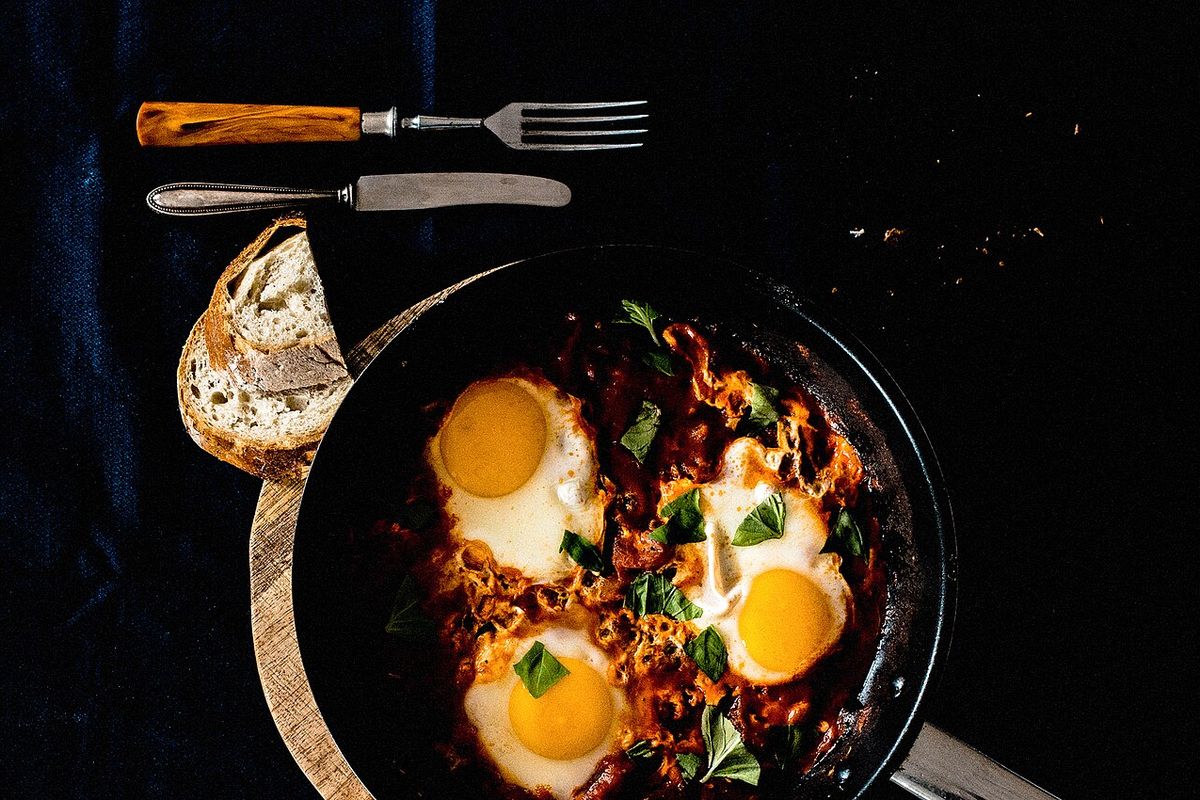
Shakshuka is a dish of eggs poached in a sauce of tomatoes, olive oil, peppers, onion and garlic, usually spiced with cumin, paprika and a little cayenne. It is cooked and eaten across North Africa and the Middle East, and it works as breakfast, lunch or a light dinner. The name is commonly explained as meaning "mixture" in Algerian and Tunisian Arabic, which suits a pan where everything is cooked together and then shared at the table.
Where the dish began is not fully settled. The food writer Gil Marks has suggested that it grew out of the Ottoman dish şakşuka and reached the Maghreb through Ottoman influence. Other researchers connect it to a wider family of vegetable stews around the western Mediterranean, which includes piperade and ratatouille. What is better documented is its later travel: the migration of Maghrebi Jews in the 1950s brought shakshuka to Israel, where it was widely adopted. The sources we used are listed at the end of this page.
This version is built for a home kitchen. It uses canned tomatoes, which give a steady result all year, and a single wide pan. The goal is a thick, jammy sauce with the sweetness of cooked peppers and a warm, not fiery, spice, with eggs whose whites are set and whose yolks are still soft. Put the pan on the table with plenty of bread and let everyone scoop.
Ingredients and substitutions
Quantities are for 4 servings.
For the sauce
- 3 tablespoons (45 ml) olive oil
- 1 large (280 g) yellow onion, finely chopped
- 2 medium (300 g) red bell peppers, seeded and diced
- 4 cloves garlic, minced
- 2 tablespoons (30 g) tomato paste
- 2 teaspoons (4 g) ground cumin
- 2 teaspoons (5 g) sweet paprika
- ¼ teaspoon (0.5 g) cayenne pepper, or Aleppo pepper flakes
- 28 oz (800 g) canned whole peeled tomatoes, crushed by hand, with their juices
- ¾ teaspoon (4 g) fine salt
- ½ teaspoon (2 g) sugar, optional, only if the tomatoes taste sharp
- freshly ground black pepper, to taste
To finish
- 6 large eggs
- ¼ cup (15 g) fresh parsley or cilantro, chopped
- ½ cup (75 g) feta cheese, crumbled, optional
- crusty bread or warm pita, for serving
Choosing your ingredients
Canned whole peeled tomatoes are the most reliable base. They are picked ripe and packed within hours, so the sauce tastes the same in January as in August. Crush them with your hands in a bowl and leave some pieces the size of a walnut; a blender makes the sauce too smooth and the eggs lose their landing place. If you prefer fresh tomatoes, use about 2 pounds (900 g) of very ripe ones, grated or chopped, and plan for 10 to 15 extra minutes of simmering to cook off their water.
Red bell peppers give the sweetest result. Green peppers are more grassy and slightly bitter, which some cooks like, so a mix of one red and one green is a fair compromise. Dice them evenly, about the size of a pea or a little bigger, so they soften at the same speed as the onion.
Spices decide how the sauce tastes, and ground spices fade. If your cumin or paprika has been open for more than a year, it will taste dusty, so buy a small jar and use it up. Cayenne is only there for background heat. For more kick, add Aleppo pepper flakes or a spoonful of harissa at the end and taste as you go.
Use a wide pan, about 12 inches (30 cm), with a lid. Cast iron, stainless steel and enameled pans all work. The pan must be wide enough that six wells in the sauce do not touch each other. If you have no lid, a flat baking sheet set on top works almost as well.
Possible substitutions
- Canned tomatoes: 2 pounds (900 g) ripe fresh tomatoes, grated or chopped. Simmer longer, until the sauce is thick.
- Cayenne pepper: Red pepper flakes or Aleppo pepper. Or 1 tablespoon harissa added with the tomatoes; reduce the salt a little because harissa is salty.
- Sweet paprika: 1 teaspoon smoked paprika for a smokier, deeper flavor.
- Feta cheese: Crumbled goat cheese, or leave it out. The dish is good without cheese.
- Parsley or cilantro: Either herb, or a few chopped mint leaves. Use whichever you have.
- Sugar: Leave it out, or stir in a small grated carrot with the onion to round off the acidity.
Step-by-step method
- Prepare the vegetables. Dice the onion and the peppers into small, even pieces, about a quarter inch (6 mm). Even pieces soften at the same speed, so nothing stays raw while something else burns. Pour the canned tomatoes into a bowl and crush them with your hands, leaving some chunks. Keep all the juice, because you need it for the sauce.
- Soften the onion and peppers. Warm the olive oil in a deep 12-inch (30 cm) skillet over medium heat. Add the onion, the peppers and a pinch of the salt. Cook for 8 to 10 minutes, stirring now and then, until the vegetables are soft and shiny and just starting to color at the edges. You want sweetness, not deep browning.
- Toast the garlic, paste and spices. Add the garlic, tomato paste, cumin, paprika and cayenne. Stir constantly for 1 to 2 minutes, until the paste darkens to a brick red and the spices smell toasted. If anything sticks to the pan, add a splash of water and scrape. Do not walk away during this step, because garlic and ground spices turn bitter if they scorch.
- Simmer the sauce until thick. Pour in the crushed tomatoes with their juice, then add the rest of the salt, some black pepper and the sugar if the tomatoes taste sharp. Bring to a gentle simmer, lower the heat to medium-low and cook uncovered for 12 to 15 minutes, stirring occasionally. The sauce is ready when a spoon dragged across the bottom leaves a trail that fills in slowly. Taste it and adjust the salt now, because you cannot season the sauce once the eggs are in.
- Make wells and add the eggs. Use the back of a spoon to press six shallow wells into the sauce, spaced apart. Crack each egg into a small cup first, then slide it into a well. This avoids shell in the pan and keeps a broken yolk from ruining the whole dish. Sprinkle the eggs very lightly with salt and pepper.
- Cook the eggs. Cover the pan and cook over low heat for 5 to 8 minutes. Start checking at 5 minutes. The whites should be opaque and set, and the yolks should still look glossy and wobble when you tilt the pan. For firmer yolks, give it 2 to 3 more minutes. The eggs keep cooking in the hot sauce after you take the pan off the heat, so pull it a little early.
- Finish and serve. Remove the pan from the heat and scatter the herbs and feta over the top. Bring it to the table in the pan, with bread for scooping up the sauce and the yolks. Serve right away, while the sauce is hot and the yolks are still soft.
Variations
Shakshuka has many regional versions. Common additions include preserved lemon, olives, harissa, salty sheep's-milk cheeses and spicy sausages such as chorizo or merguez. Tunisian cooks may add potatoes, broad beans, artichoke hearts or zucchini. In Egypt the eggs are poached in a spiced tomato sauce and often served with baladi bread, sometimes with a sprinkle of domiati cheese.
For a heartier pan, stir in a can of drained chickpeas (15 oz, or about 400 g) with the tomatoes. For a version with greens, add 5 ounces (140 g) of baby spinach after the sauce has thickened and let it wilt for a minute before you make the wells. For a meat version, brown 8 ounces (225 g) of ground lamb with the onions and drain off excess fat before adding the spices.
Storage and reheating
The sauce keeps well. Cool it quickly, within two hours of cooking, and store it in an airtight container in the refrigerator for up to 3 or 4 days. It also freezes for around 3 months. For the best result, store the sauce without the eggs and poach fresh eggs in it when you want to eat.
Reheat the sauce in a pan over medium heat with a splash of water until it simmers, then add the eggs as in the recipe. Leftover shakshuka that already contains eggs can be reheated, but the yolks will be fully firm. Heat leftovers until they are steaming hot all the way through, to 165°F (74°C), and eat them within a day or two.
Common mistakes
- Adding the eggs to a thin sauce. A watery sauce leaves the eggs floating, cooks them unevenly and makes the dish soupy. Wait until a spoon leaves a trail in the sauce that closes slowly.
- Scorching the spices. Garlic, paste and ground spices burn in seconds. Keep the heat at medium, stir constantly and add a splash of water if the pan looks dry.
- Overcooking the eggs. Eggs go from perfect to rubbery quickly under a lid. Check at 5 minutes and remember that the hot sauce keeps cooking them after the heat is off.
- Using a pan that is too small. In a crowded pan the wells touch, the whites run together and the eggs cook unevenly. Use a 12-inch (30 cm) pan, or halve the recipe for a smaller one.
- Seasoning too late. Salt the sauce while it simmers and taste it before the eggs go in. Salt added at the end only sits on top of the eggs and never reaches the sauce.
Frequently asked questions
Is shakshuka a breakfast or a dinner dish?
Both. Because the main ingredient is eggs, it often appears on breakfast menus in many countries, but in the Arab world and in Israel it is also a popular evening meal. It works whenever you want something warm, savory and quick.
Can I bake it instead of cooking it on the stove?
Yes. After you add the eggs, move an ovenproof skillet to a 375°F (190°C) oven and bake for about 8 to 10 minutes, until the whites are set. Use the same visual cues as on the stove, and take care with the hot handle.
Are runny yolks safe?
A soft yolk carries a small risk of foodborne illness. Young children, older adults, pregnant people and anyone with a weakened immune system should eat eggs cooked until both the white and the yolk are firm. For them, cook the shakshuka 3 to 5 minutes longer than the recipe says.
How do I make it milder or hotter?
For a milder dish, leave out the cayenne and keep the sweet paprika and cumin. For more heat, add more cayenne in small steps, or stir in harissa or Aleppo pepper at the end, tasting after each addition.