Middle East & Africa
Mujaddara: Lentils and Rice with Caramelized Onions
Brown lentils and rice cooked with cumin, piled with slow-browned onions and served with yogurt and a fresh salad, in about an hour.
By Lavin Food Editorial · Published
- Prep
- 15 min
- Cook
- 55 min
- Total
- 1 hr 10 min
- Yield
- 6 servings
About this dish
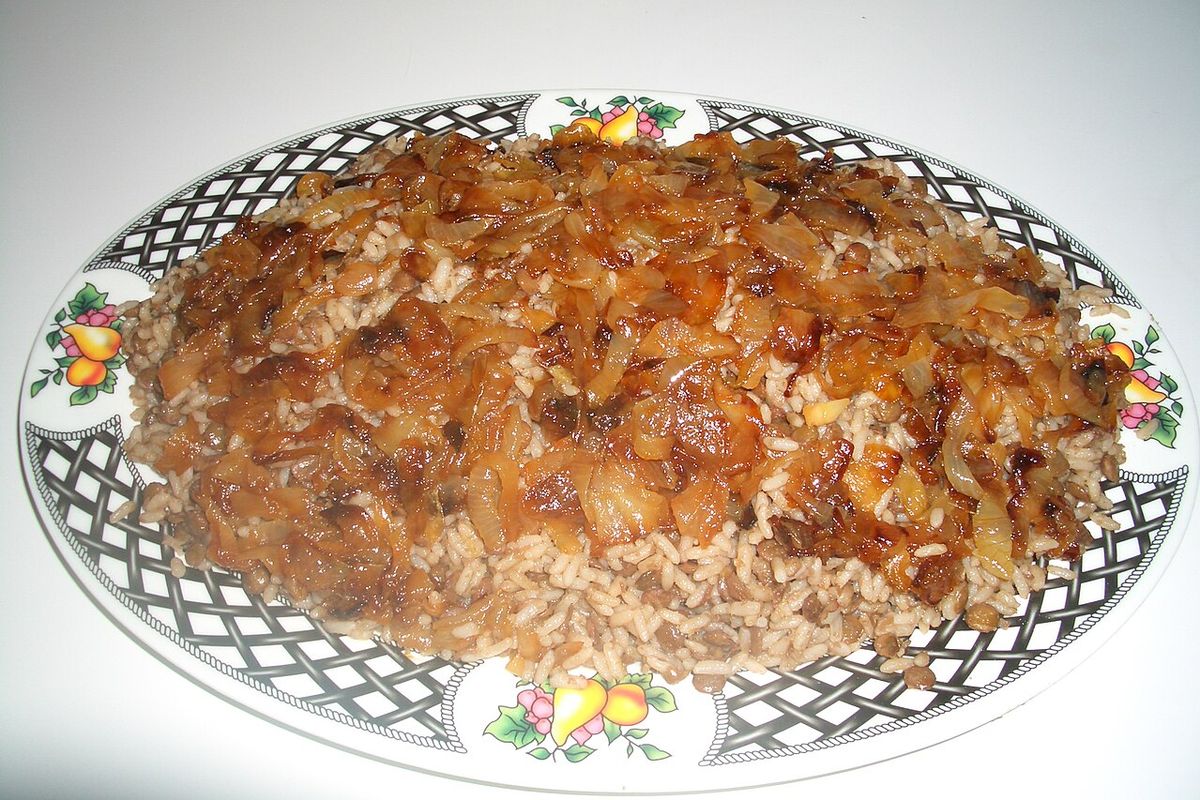
Mujaddara is a dish of cooked lentils and a grain, usually rice, topped with sautéed onions. It is especially popular in the Levant, and it is eaten hot or cold. Spellings vary a great deal. Wikipedia lists majadra, mejadra, moujadara, mudardara and megadarra, so you may meet any of them on a menu or in another cookbook. The Arabic name is given as meaning "pockmarked," a reference to the way the lentils dot the rice.
Its past is better recorded than that of many home dishes. The first written recipe is said to appear in Kitab al-Tabikh, a cookbook compiled in 1226 by al-Baghdadi. That version used rice, lentils and meat and was served at celebrations. Without the meat, mujaddara is described as a medieval Arab dish commonly eaten by poorer people. The food historian Gil Marks is cited as saying that the Persians brought rice to the Middle East from India, but that nobody knows who first paired rice with lentils. A saying from the eastern Arab world claims a hungry man would sell his soul for a plate of it.
This version cooks the lentils first and adds the rice later, because lentils take longer to soften. The onions are browned slowly in olive oil until they turn deep brown and sweet, with a few crisp edges. Cumin runs through the pot, and the plate is finished with yogurt and a cool tomato and cucumber salad. The aim is separate grains and whole lentils, not a mush.
Ingredients and substitutions
Quantities are for 6 servings.
For the lentils and rice
- 1 cup (200 g) brown or green lentils, rinsed, stones removed
- 4 cups (960 ml) water
- 1 cup (185 g) long-grain white rice, rinsed until the water runs nearly clear, then drained
- 2 teaspoons (4 g) ground cumin
- 1 teaspoon (2 g) ground coriander, optional
- 1½ teaspoons (9 g) fine salt, divided, plus more to taste
- freshly ground black pepper, to taste
For the onions
- 3 large (840 g) yellow onions, halved and sliced thin, about 1/8 inch (3 mm)
- ⅓ cup (80 ml) olive oil
To serve
- 1½ cups (370 g) plain whole-milk yogurt
- 3 medium (450 g) tomatoes, diced
- 2 medium (400 g) cucumbers, diced
- ½ cup (15 g) fresh parsley, chopped
- 2 tablespoons (30 ml) lemon juice
- 2 tablespoons (30 ml) olive oil, for the salad
Choosing your ingredients
Use brown or green lentils. They keep their shape through a long simmer and give the dish its dotted look. Red or yellow split lentils break down into a purée within minutes, which would turn the pot into porridge. Rinse the lentils in a sieve and look through them for small stones or shriveled ones before cooking.
Long-grain white rice works best because the grains stay separate. Basmati is a good choice and cooks a little faster than other long-grain rice. Rinse it until the water is only slightly cloudy, which removes loose starch that would make the grains stick together. Do not stir the rice once it is in the pot.
Onions are the main flavor, so buy more than seems reasonable. Three large onions shrink to a modest pile. Yellow onions are sturdy and brown evenly. Cut them into thin, even half-moons, because thick slices stay pale in the middle while the edges burn. A wide, heavy skillet gives the onions room to lose their water and then brown. In a crowded pan they steam and turn gray.
Cumin is the main spice, and coriander is optional. Wikipedia notes that mujaddara can be seasoned with cumin, coriander or mint. Use ground spices that smell strong when you open the jar. Salt matters more than usual here, because lentils and rice both soak up a lot of it. Taste the finished pot and add more if the grains taste flat.
Possible substitutions
- Brown or green lentils: French green (Puy) lentils also work and stay firmer. Cook them 2 to 5 minutes longer. Do not use red split lentils.
- Long-grain white rice: Basmati rice, or medium-grain rice for a softer, stickier result. Brown rice takes about 40 minutes, so cook it in its own pot and fold it in at the end.
- Rice: Coarse bulgur, in the same amount. Add it after the lentils and cook it for about 12 to 15 minutes, checking the package for timing.
- Olive oil for the onions: Any neutral oil, such as sunflower or canola, for a lighter flavor. Browning also works with part oil and part butter.
- Plain whole-milk yogurt: Greek yogurt thinned with a spoonful of water, or labneh. For a dairy-free plate, skip it and add extra lemon juice to the salad.
- Ground coriander: A handful of chopped fresh mint stirred in at the end, or leave the coriander out. The dish is good with cumin alone.
Step-by-step method
- Slice and rinse. Cut the onions in half through the root, peel them and slice into thin half-moons, about 1/8 inch (3 mm). Rinse the lentils in a sieve, picking out any stones. Rinse the rice in a bowl of cool water, swishing it and pouring off the water three or four times, until the water is only faintly cloudy. Drain the rice well and set it aside.
- Start the onions. Heat the oil in a wide, heavy 12-inch (30 cm) skillet over medium heat. Add the onions with a pinch of salt. Cook for about 10 minutes, stirring often, until they wilt and turn glossy. Lower the heat to medium-low and keep going for 25 to 35 minutes, stirring every few minutes, until they are deep brown. If they darken in patches, add a splash of water and lower the heat.
- Cook the lentils first. While the onions cook, put the lentils and water in a 3- to 4-quart (3 to 4 liter) pot. Bring to a boil, skim off any foam, then reduce to a steady simmer with the lid slightly ajar. Cook for 18 to 22 minutes. The lentils are ready for the rice when they are tender but still hold their shape, and a lentil pressed between two fingers has no hard center.
- Add the rice and spices. Stir in the drained rice, the cumin, the coriander if using, most of the remaining salt, some black pepper and a spoonful of the oil from the onion pan. The liquid should sit about 1/2 inch (1 cm) above the grains, so add hot water if it is lower. Bring to a boil, stir once, cover and cook on the lowest heat for 15 to 18 minutes, until the water is absorbed and small steam holes show on the surface.
- Rest the pot. Turn off the heat. Lay a clean kitchen towel over the pot and set the lid on top so the towel catches the steam. Leave it alone for 10 minutes. The rice finishes cooking in the steam and the grains firm up. Then fluff gently with a fork, lifting from the bottom. Taste a spoonful and add salt if it tastes flat. The rice should be tender, with no chalky center.
- Make the salad. While the rice rests, toss the tomatoes, cucumbers and parsley in a bowl with the lemon juice, the salad oil and a pinch of salt. Leave it for 5 minutes so the juices mingle. Spoon the yogurt into a bowl and stir in a pinch of salt. Keep both cold until you are ready to serve, and drain extra liquid from the salad just before it goes on the table.
- Crisp the onions. If the onions finished early, they will keep. Just before serving, raise the heat to medium-high and stir for 2 to 4 minutes. They should sizzle, darken to the color of dark tea and crisp at the edges. Watch closely, because they can go from brown to bitter in under a minute. Pull the pan off the heat and keep the oil that is left.
- Assemble and serve. Spread the rice and lentils on a wide platter. Fold about a third of the onions into the grains, then pile the rest on top. Spoon a little of the onion oil over the plate. Serve warm, with the yogurt and the salad on the side. Each person can mix some yogurt into the rice as they eat.
Variations
Regional versions differ in texture and grain. Wikipedia notes that in Lebanon the word mjaddara refers to a puréed version with the consistency of rice pudding, while the version called mudardara keeps the rice and lentils fairly whole and distinct. Both are topped with caramelized onions and usually served with yogurt or a salad. Some Palestinian cooks replace the rice with bulgur, and the dish is then called m'jaddaret-burghul. The version in this recipe is closer to mudardara. Arab Christians are said to eat mujaddara traditionally during Lent, and it is also popular in Sephardic and Druze communities.
For crisper onions, fry them instead of browning them slowly. Use a deep skillet with about 1/2 inch (1.5 cm) of oil and heat it to about 350°F (175°C). Fry the onions in two or three batches for 8 to 12 minutes, until deep golden, and drain them on paper towels. They crisp further as they cool. Never leave hot oil unattended. Keep a lid nearby to smother any flames, and do not pour water on burning oil. Similar dishes include kushari in Egypt, khichdi in India and addas polo in Iran, each combining lentils and rice in its own way.
Storage and reheating
Cool leftovers quickly and refrigerate them within two hours of cooking. Spread the rice and lentils in a shallow container so they cool fast, and cover it. Keep the onions in a separate container so they stay crisp. Everything keeps in the refrigerator for 3 to 4 days. The rice and lentils also freeze well for up to 3 months. Freeze them flat in a bag so they thaw evenly.
Reheat the rice and lentils in a covered pan or microwave with a splash of water, stirring once or twice, until steaming hot all the way through, to 165°F (74°C). Warm the onions in a dry skillet for a minute or two to bring back some crispness. Keep the yogurt and salad cold, and make the salad fresh if you can, since cut tomatoes and cucumbers turn watery within a day.
Common mistakes
- Using red lentils. Red and yellow split lentils dissolve into a paste. Brown or green lentils keep their shape and give the dish its look and bite. If you only have red lentils, make a lentil soup instead.
- Adding the rice too early. Lentils need about 20 minutes before the rice goes in. If everything starts together, the rice turns to mush before the lentils soften. Cook the lentils first, then add the rice.
- Rushing the onions. High heat burns the outside of the onions and leaves the inside raw and sharp. Give them 35 to 45 minutes over medium to medium-low heat, stirring often. Dark brown and sweet is the goal, not black and bitter.
- Crowding the skillet. Piled-up onions steam in their own water and never brown. Use a wide pan, and cook the onions in two pans or two batches if they fill it more than about two inches (5 cm) deep.
- Stirring the rice and lifting the lid. Stirring after the rice goes in releases starch and makes the grains gummy. Peeking lets the steam escape. Stir once, cover and leave the pot alone until the timer ends.
- Under-salting. Lentils and rice taste flat without enough salt. Season the water, then taste the finished pot and adjust. The onions and yogurt add little salt of their own.
Frequently asked questions
Can I make mujaddara with red lentils?
It is not recommended. Red lentils cook in about 10 minutes and fall apart, so you would get a soft purée. A purée is a real style in some places, but it is a different dish. Brown or green lentils give the whole-grain texture in this recipe.
How dark should the onions be?
Deep brown, like strong tea, with some crisp edges. The slow method takes about 35 to 45 minutes and gives soft, sweet, jammy onions. Frying them in more oil for a shorter time gives crunchier, drier onions. Both are traditional, so pick the texture you like.
Can I make it ahead?
Yes. The rice and lentils hold well in the refrigerator for 3 to 4 days, and the onions can be browned a day ahead. Reheat the grains until steaming hot and give the onions a minute in a dry skillet. Make the salad fresh.
Is mujaddara vegan?
The dish itself contains no animal products when it is cooked with olive oil, as here. The yogurt on the side is optional, so leave it off for a vegan plate. Older recipes, like the 1226 one Wikipedia mentions, also used meat.
Can I use canned lentils?
Yes, but the method changes. Canned lentils are already cooked. Cook the rice with the cumin and salt in about 1 1/2 cups (360 ml) of water, then fold in about 2 cups (400 g) of drained, rinsed canned lentils and warm them through for 5 minutes. Top with the onions as usual.