European Classics & Core Techniques
Potato Gratin (Gratin Dauphinois): Creamy Layered Potatoes
Thin potato slices simmered briefly in garlic cream, then baked until tender with a golden top. A classic French side dish for six.
By Lavin Food Editorial · Published
- Prep
- 25 min
- Cook
- 1 hr
- Total
- 1 hr 25 min
- Yield
- 6 servings
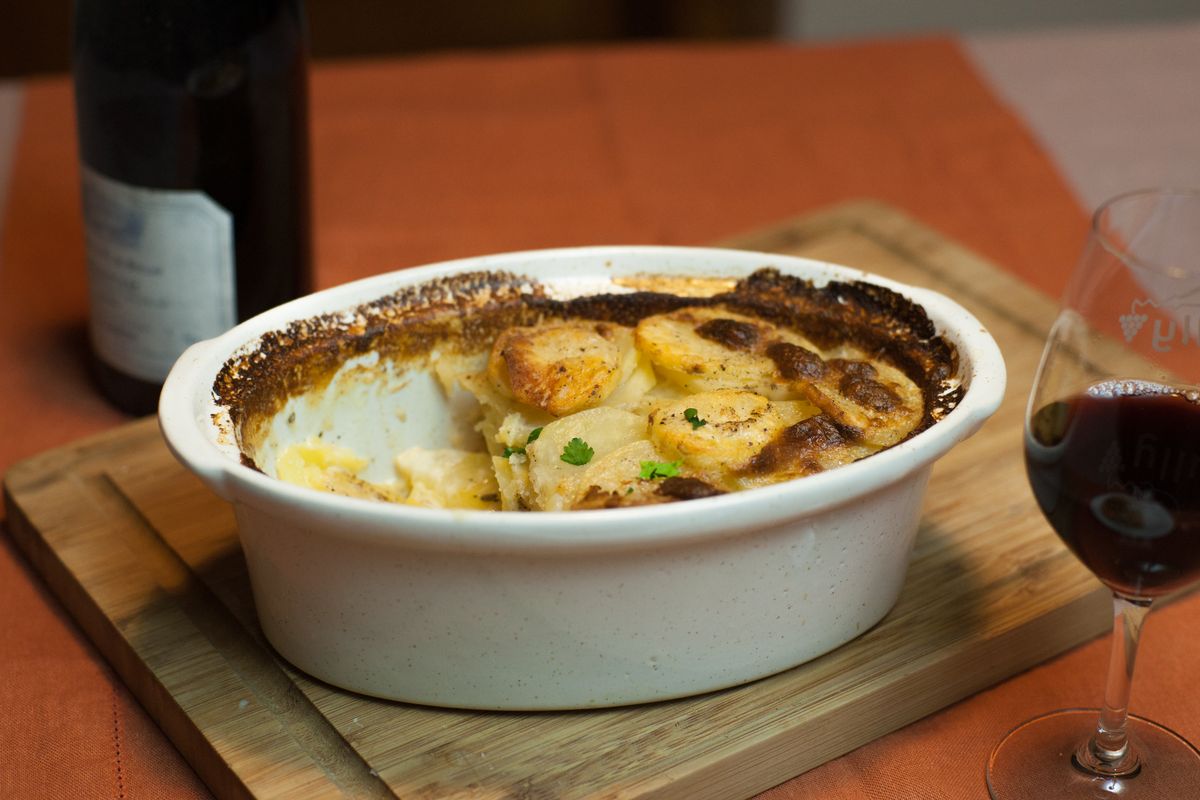
About this dish
Gratin dauphinois is a French gratin of sliced raw potatoes baked in cream. Wikipedia places it in the Dauphiné region of south-eastern France and gives the first written mention as a dinner on 12 July 1788, given for the town officials of Gap, where it was served with ortolans. That is the earliest record the source offers, not proof of where or when the dish began.
The word gratin names a method more than one dish. Wikipedia describes a gratin as a shallow dish baked or broiled until a golden crust forms on top. Many potato bakes use it, and their names overlap. Scalloped potatoes and potatoes au gratin are common names for similar dishes, and the old rule that au gratin means cheese has mostly faded.
Cheese is the usual argument. By tradition, gratin dauphinois has none, and Wikipedia notes that cheese pushes it toward the gratin savoyard, a neighboring dish made with Beaufort cheese and bouillon instead of cream. Yet several well-known chefs' recipes call for cheese, eggs or both. Sources disagree, so the main recipe below is cheese-free and Gruyère is an option.
Here the slices simmer briefly in seasoned cream on the stove before the bake. That step cooks them evenly and keeps the sauce smooth.
Ingredients and substitutions
Quantities are for 6 servings.
For the gratin
- 2 pounds (900 g) Yukon Gold potatoes, peeled
- 3 cloves garlic, 1 clove halved to rub the dish, 2 cloves minced
- 2 tablespoons (28 g) unsalted butter, half for the dish, half for dotting on top
- 1½ cups (360 ml) heavy cream
- ½ cup (120 ml) whole milk
- 1 teaspoon (6 g) fine salt
- ⅛ teaspoon (0.3 g) freshly grated nutmeg
- freshly ground black pepper, to taste
Optional
- 1 cup (100 g) Gruyère cheese, grated, for a cheesy version
- 1 teaspoon (1 g) fresh thyme leaves, for serving
Choosing your ingredients
Yukon Gold potatoes sit between waxy and starchy. The slices hold their shape and still release enough starch to thicken the cream. Very waxy potatoes, such as red ones, stay firm but make a looser sauce. Russets give the thickest sauce, but the slices can break down and turn mushy.
Do not rinse the slices after cutting. The starch on the surface thickens the cream into a smooth sauce, and rinsing leaves a thin, watery bake. Slice just before cooking, because cut potatoes darken within about 30 minutes.
Heavy cream stands up to heat best, and the splash of whole milk keeps the dish from tasting too heavy. Lower-fat dairy such as half-and-half is more likely to separate in the oven. Season the cream well, because potatoes soak up a lot of salt.
Use a dish of about 2 quarts (2 liters), such as a 9-inch (23 cm) square dish, set on a rimmed baking sheet to catch drips. Cut the slices 1/8 inch (3 mm) thick, about the thickness of a coin. A mandoline gives the most even slices; always use its hand guard, because the blade is very sharp.
Possible substitutions
- Yukon Gold potatoes: Russet potatoes for a thicker sauce and softer slices, or red potatoes for firmer slices and a thinner sauce. Keep the 1/8 inch (3 mm) thickness.
- Heavy cream and whole milk: 2 cups (480 ml) heavy cream alone for a richer dish. Half-and-half works, but the sauce is thinner and separates more easily.
- Gruyère cheese: Comté, Emmental or Swiss cheese, in the same amount, or leave it out for the traditional version.
- Nutmeg: A pinch of white pepper, or leave it out.
- Unsalted butter: Salted butter, with the added salt reduced to 3/4 teaspoon (4 g).
Step-by-step method
- Heat the oven and prepare the dish. Set a rack in the middle and heat the oven to 350°F (175°C), which takes 10 to 15 minutes. Rub the cut side of the halved garlic clove over the inside of a 2-quart (2 L) dish, then spread half the butter on the surface. The dish should smell of garlic and look evenly glossy. Set it on a rimmed baking sheet.
- Peel and slice the potatoes. Peel the potatoes and slice them 1/8 inch (3 mm) thick with a mandoline and its guard, or a sharp knife. This takes about 10 minutes. Good slices are even, nearly translucent at the edges and bend without snapping. Do not rinse them. Keep the slices dry in a large bowl so the starch stays on the surface.
- Warm the cream. In a wide, heavy pot, combine the cream, milk, minced garlic, salt, nutmeg and several grinds of pepper. Warm over medium heat for 3 to 4 minutes, stirring now and then, until small bubbles appear at the edge and steam rises. Do not boil hard, because high heat can make dairy separate. The liquid should taste pleasantly salty.
- Simmer the potatoes in the cream. Add the slices and press them under the cream. Cook over medium-low heat at a gentle simmer for 6 to 8 minutes, stirring carefully every minute and scraping the bottom. The sauce is ready when it looks thicker, like pouring cream, and coats the back of a spoon. The slices should bend easily but still feel firm in the center.
- Fill the dish. Pour the potatoes and cream into the dish and press them gently with a spatula so the layers lie flat and the cream comes nearly to the top of the slices. Scatter on the Gruyère if using. Cut the remaining butter into small pieces and dot it over the top. The surface should look level and glossy.
- Bake until golden. Bake on the middle rack for 45 to 55 minutes. If the top darkens fast, cover it loosely with foil for the first 25 minutes. The gratin is done when the top is golden brown, the edges bubble slowly and a thin knife slides through the center with almost no resistance. If any slices feel firm, bake 5 to 10 minutes more.
- Rest before serving. Let the dish stand uncovered for 10 to 15 minutes. The sauce looks loose at first, then thickens as it cools slightly, and the layers hold together when cut. Scatter thyme over the top if you like, cut into squares and lift them out with a wide spatula.
Variations
For a cheesy version, add 1 cup (100 g) of grated Gruyère across the top, or put half between two layers. A mix of Gruyère and Parmesan browns more deeply. Wikipedia describes the traditional dauphinois as cheese-free, so skip it if you want to follow that rule.
Stir 2 tablespoons of chopped fresh thyme into the cream, or drop a bay leaf into the pot and remove it before baking. Thinly sliced leeks, softened in butter first, add a savory note. Sweet potatoes can replace half the potatoes, but they cook faster, so check at 40 minutes.
Storage and reheating
Refrigerate leftovers within two hours of baking, in the covered dish or an airtight container, for 3 to 4 days. The gratin can also be baked a day ahead, cooled, covered and reheated before dinner.
Reheat covered with foil in a 350°F (175°C) oven for 20 to 30 minutes, then uncover for the last 5 minutes to crisp the top. Heat until the center reaches 165°F (74°C). Freezing for about 3 months is possible, but the cream may separate and the potatoes can turn grainy.
Common mistakes
- Rinsing the slices. The surface starch thickens the sauce. Rinsing leaves a thin, watery gratin, so slice just before cooking and keep the slices dry.
- Uneven slices. Thick slices stay hard while thin ones turn to mush. Aim for 1/8 inch (3 mm) throughout, using a mandoline with its guard.
- Boiling the cream. A hard boil can make cream separate and look curdled. Keep a gentle simmer, stir often and bake at 350°F (175°C).
- Under-seasoning the cream. Potatoes absorb a lot of salt. Taste the warm cream before the slices go in; it should taste slightly salty on its own.
- Cutting it too soon. Straight from the oven the sauce is loose and runs out of the cut. Rest the dish 10 to 15 minutes so the layers can set.
Frequently asked questions
Is gratin dauphinois made with cheese?
By tradition, no. Wikipedia says the classic dish has no cheese, though many chefs' recipes add it. This recipe is cheese-free, with Gruyère as an option.
Why did my cream curdle or look split?
Dairy separates when it is boiled hard or when the fat is low. Use heavy cream and keep the heat gentle. A split gratin is still safe to eat; stir the sauce into the potatoes and serve.
Can I make it ahead?
Yes. Bake it fully, cool it, cover it and refrigerate for up to a day. Reheat covered at 350°F (175°C) for 20 to 30 minutes, until hot all the way through.
How do I know the potatoes are done?
Push a thin knife into the center. It should slide in with almost no resistance. If you feel firm spots, bake another 5 to 10 minutes and test again.