European Classics & Core Techniques
Beef Bourguignon: Red Wine Braise with Mushrooms and Onions
Beef chuck braised in the oven with red wine, bacon and stock, then finished with browned mushrooms and pearl onions.
By Lavin Food Editorial · Published
- Prep
- 40 min
- Cook
- 3 hr 30 min
- Total
- 4 hr 10 min
- Yield
- 6 servings
About this dish
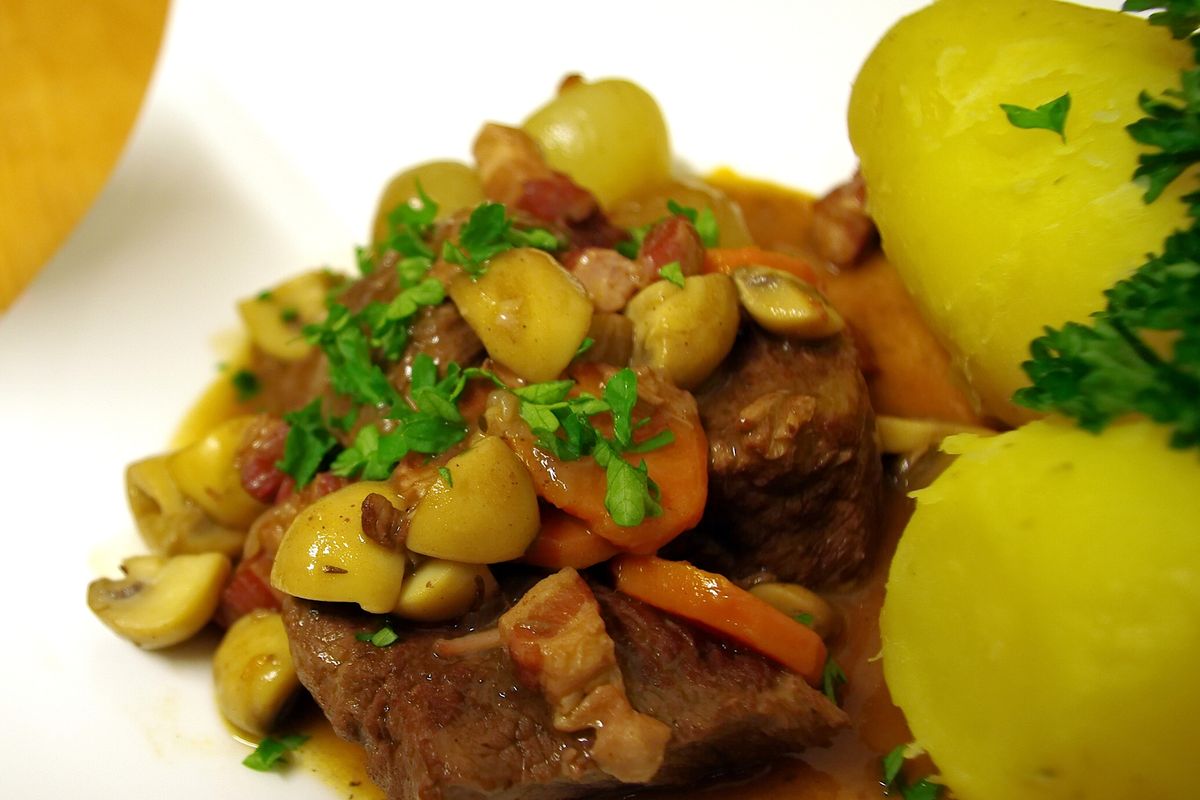
Beef bourguignon is a French stew of beef braised in red wine and beef stock. Wikipedia describes it as typically flavored with carrots, onions, garlic and a bouquet garni, and garnished with pearl onions and mushrooms. The wine is often red Burgundy, but any dry red you would happily drink will do.
The name suggests an old country recipe from Burgundy, but the history is less tidy. The same source says the dish was first documented in 1867, that it is probably not a regional recipe from Burgundy, and that it only began to be seen as a Burgundian specialty in the twentieth century. Other mid-1800s dishes "à la bourguignonne", such as leg of lamb and rabbit, used a similar garnish.
Braising is the method that makes it work. Food is browned at high heat, then simmered in a covered pot with some liquid, often with an acidic part such as wine or tomato. Slow heat softens the tough connective tissue in cuts like chuck, and the liquid becomes the sauce. Here the garnish is cooked separately and added at the end, so it keeps its color and texture.
Ingredients and substitutions
Quantities are for 6 servings.
For the braise
- 3 pounds (1.35 kg) beef chuck roast, trimmed, cut into 2-inch (5 cm) cubes
- 6 oz (170 g) thick-cut bacon, cut into 1/2-inch (1.25 cm) strips, or lardons
- 2 teaspoons (12 g) fine salt
- freshly ground black pepper, to taste
- 1 tablespoon (15 ml) olive oil, if needed for browning
- 2 large (250 g) carrots, peeled, cut into 1/2-inch (1.25 cm) rounds
- 1 large (280 g) yellow onion, diced
- 3 cloves garlic, minced
- 1 tablespoon (15 g) tomato paste
- 2 tablespoons (15 g) all-purpose flour
- 3 cups (720 ml) dry red wine, a bottle you would drink
- 1½ cups (360 ml) beef stock, low-sodium
- 6 sprigs fresh thyme
- 2 whole dried bay leaves
For the garnish
- 10 oz (280 g) pearl onions, fresh, peeled, or frozen and thawed
- 1 pound (450 g) cremini mushrooms, halved, or quartered if large
- 3 tablespoons (42 g) unsalted butter, divided
- 2 tablespoons (8 g) fresh parsley, chopped, for serving
Choosing your ingredients
Chuck roast has plenty of connective tissue and fat. Over a long, gentle braise that tissue melts and makes the sauce silky, while lean cuts such as round dry out. Keep the cubes about 2 inches (5 cm) wide: smaller pieces fall apart, and larger ones take much longer to soften.
Choose a dry, medium-bodied red such as a Pinot Noir, and skip anything labeled cooking wine, which is salty and thin. Simmering reduces the alcohol in the pot but does not remove all of it. If someone at the table avoids alcohol, serve them a different dish.
Bacon adds smoke, salt and fat for the vegetables. If it is very salty, or the stock is not low-sodium, hold back some salt and season at the end.
Fresh pearl onions are sweet but tedious to peel. Drop them into boiling water for 1 minute, cool them under cold water and slip off the skins. Frozen peeled ones are a fair shortcut. Use a heavy 5 to 6-quart (4.7 to 5.7 L) Dutch oven with a tight lid.
Possible substitutions
- Beef chuck roast: Boneless beef short ribs or beef shank, cut in large pieces. Both are rich and may need a little longer.
- Bacon: Pancetta or salt pork, or skip it and brown the beef in 2 tablespoons (30 ml) of olive oil.
- Pearl onions: 8 ounces (225 g) of shallots, peeled and halved.
- Fresh thyme: 1 teaspoon (1 g) of dried thyme, added with the stock.
Step-by-step method
- Dry and season the beef. Heat the oven to 325°F (160°C) with a rack in the lower third. Pat the beef cubes very dry on every side with paper towels, since dry surfaces brown and damp ones steam. Season with the salt and pepper and let the meat sit about 10 minutes while you start the bacon.
- Render the bacon. Set a Dutch oven over medium heat and add the bacon. Cook for 6 to 8 minutes, stirring now and then, until the fat has melted and the pieces are golden at the edges. Lift the bacon out with a slotted spoon. Leave about 2 tablespoons (30 ml) of fat in the pot, and add the olive oil if there is less.
- Brown the beef in batches. Raise the heat to medium-high. Add about a third of the beef in one layer with space between pieces. Leave it alone for 3 to 4 minutes, until the underside is deep brown, then turn and brown the other sides for 5 to 6 minutes more. Move each batch to the plate with the bacon. A crowded pot steams the meat and leaves it gray.
- Cook the vegetables, paste and flour. Lower the heat to medium. Add the carrots and onion and cook for 6 to 8 minutes, scraping up the browned bits, until the onion is soft and golden. Stir in the garlic and tomato paste for 1 minute, until the paste darkens, then the flour for 1 minute.
- Add the wine and stock. Pour in the wine and scrape the bottom of the pot clean. Simmer over medium-high heat for 6 to 8 minutes, until the sharp smell of alcohol fades and the liquid has reduced by about a quarter. Add the stock, thyme and bay leaves. Return the beef and bacon with their juices. The liquid should come almost to the top of the meat.
- Braise in the oven. Bring the pot to a gentle simmer on the stove, cover, and slide it into the oven. Cook for 2 1/2 to 3 hours. The surface should show only a few slow bubbles. The beef is done when a fork slides in with almost no resistance and a cube gives way when pressed. Judge by tenderness, not by a thermometer.
- Cook the onions and mushrooms. While the stew finishes, melt 1 tablespoon of the butter in a skillet over medium heat. Add the pearl onions with a splash of water, cover, and cook for 8 to 10 minutes, until a knife slides in easily and they are golden. Remove them. Melt the remaining butter, add the mushrooms in two batches, and cook for 6 to 8 minutes each, until browned and the pan is dry.
- Finish the sauce and serve. Take the pot out of the oven. Discard the thyme stems and bay leaves and spoon the fat off the surface. Stir in the onions and mushrooms and simmer uncovered for 10 to 15 minutes, until the sauce coats the back of a spoon. Adjust the salt and pepper, add the parsley and serve hot.
Variations
Some cooks add a splash of brandy after browning the beef, or tie the herbs into a bouquet garni so they are easy to remove. Others marinate the beef overnight in the wine. That step is optional here, because a good sear and a long braise already give a deep flavor.
To make it ahead, stop after step 6 and refrigerate the stew. The next day, lift off the fat that has set on top, reheat, and cook the onions and mushrooms fresh. A slow cooker also works: build the sauce on the stove, then cook on low for 7 to 8 hours and finish with the garnish.
Storage and reheating
Cool the stew quickly, within 2 hours of cooking, by dividing it into shallow containers, since a deep pot stays warm in the center for hours. Refrigerate in airtight containers for 3 to 4 days. The flavor tends to improve overnight as the meat takes up more of the sauce.
Freeze for about 3 months for best quality, and thaw overnight in the refrigerator. Reheat over medium-low heat, stirring now and then, until steaming hot all the way through and at least 165°F (74°C). Add a splash of stock if the sauce has tightened.
Common mistakes
- Skipping the drying step. Wet meat steams instead of browning, and the sauce loses color and depth. Pat each cube dry before it touches the pot.
- Crowding the pot. Too much meat at once drops the temperature and releases juices. Brown in three batches, leaving space between cubes.
- Cooking too hot. Hard boiling makes braised beef tough and dry. The oven should give only a few lazy bubbles. If the pot bubbles hard, lower the oven by 25°F (15°C).
- Stopping before the beef is tender. Cooked through is not the same as done. If a cube resists a fork at 2 1/2 hours, give it 20 to 30 more minutes.
- Adding the garnish too early. Mushrooms and onions added at the start turn soft and pale. Brown them separately and stir them in at the end.
Frequently asked questions
What wine should I use?
Use a dry, medium-bodied red that you would drink, such as a Pinot Noir. Red Burgundy is the traditional choice but is not required. Avoid very oaky or sweet wines.
Does the alcohol cook out?
Only partly. Simmering and long cooking reduce the alcohol but do not remove all of it. For anyone who avoids alcohol, serve a different dish.
Why is my sauce thin?
The beef and vegetables release liquid as they cook. Simmer the stew uncovered for 10 to 15 minutes after it comes out of the oven. If it is still thin, stir in a paste of 1 tablespoon (14 g) soft butter and 1 tablespoon (8 g) flour.
What should I serve with it?
Boiled or mashed potatoes are the usual partner, and pasta is also common. Buttered noodles or crusty bread catch the sauce well.