Latin America
Peruvian-Style Ceviche: Fish Cured in Lime Juice
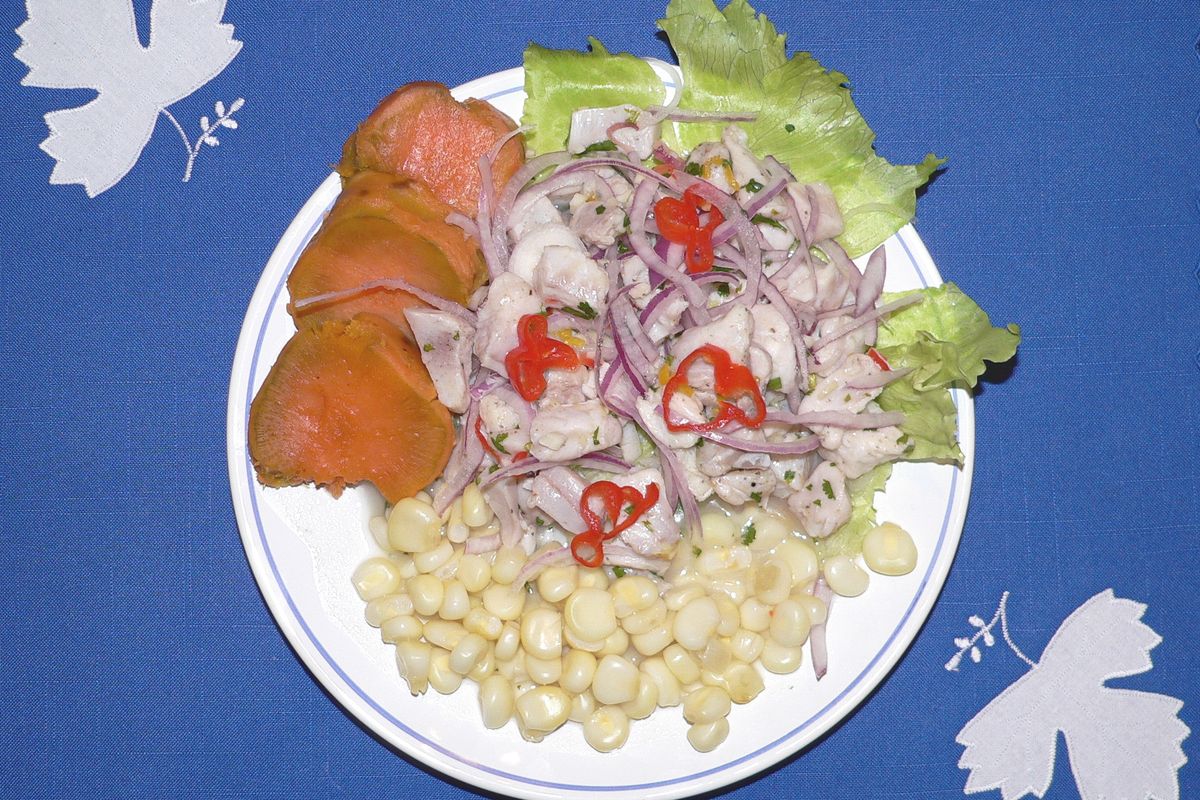
Cubed white fish cured in fresh lime juice with red onion, chile and cilantro for 10 to 15 minutes, served with sweet potato and corn.
By Lavin Food Editorial · Published
- Prep
- 30 min
- Cook
- 20 min
- Total
- 50 min
- Yield
- 4 servings
About this dish
Ceviche is a cold dish of raw fish or shellfish marinated in citrus juice and seasonings. Many Latin American countries on the Pacific coast have their own version, but Peru is the country most closely tied to it. Wikipedia calls ceviche the national dish of Peru, notes that the government set aside June 28 as National Ceviche Day in 2008, and reports that UNESCO added the practices around making and eating it to its list of Intangible Cultural Heritage in December 2023.
Where ceviche began is argued over. Peruvian researchers and archaeological evidence are said to favor a pre-Hispanic coastal origin, with early versions soured by the juice of a fruit called tumbo, since limes came with the Spanish. Other writers point to Ecuador, Spain or the Pacific islands. The sources disagree and none settles it. They do agree that today's short, cold cure is recent: older ceviche marinated for hours, and the quick style is credited to Peruvian-Japanese chefs in the 1970s.
This recipe follows that modern Peruvian style. Cubed fish is tossed with lime juice, salt, red onion, chile and cilantro and left for only 10 to 15 minutes. Peruvian ceviche does not use tomato, and it comes with boiled sweet potato and corn. The sour, salty liquid left in the bowl is called leche de tigre, or tiger's milk.
One thing must be clear before you start. This is a raw-fish dish. Lime juice changes the look and texture of the fish so it turns opaque and firm, but it does not kill bacteria or parasites the way heat does. Pregnant people, young children, older adults and anyone with a weakened immune system should not eat it. For them, use the cooked shrimp version in the variations section.
Ingredients and substitutions
Quantities are for 4 servings.
For the ceviche
- 1½ pounds (680 g) firm white fish fillets, skinless and boneless, very fresh, such as sea bass, halibut or snapper
- 1 teaspoon (6 g) fine salt
- ¾ cup (180 ml) fresh lime juice, from about 6 to 8 limes, strained
- 1 medium (150 g) red onion, sliced very thin
- 1 small fresh hot chile, such as habanero or serrano, seeded and minced
- 1 tablespoon (15 g) ají amarillo paste, optional, jarred
- ¼ cup (15 g) fresh cilantro, chopped
- freshly ground black pepper, to taste
For serving
- 2 medium (500 g) sweet potatoes, peeled
- 1½ cups (225 g) corn kernels, cooked, from choclo, or canned and drained, or frozen and thawed
- lettuce leaves, optional, for lining the plates
Choosing your ingredients
The fish decides the result. Buy it from a seller you trust and say it will be eaten raw. There is no official "sushi-grade" label to rely on, so ask direct questions: when did it arrive, was it frozen before, and would they serve it raw. It should smell clean, like the sea, and look moist. Buy it the same day and keep it on ice.
Firm, mild, white fish holds its shape in the lime juice. Sea bass, halibut, snapper and corvina are common choices. Soft or oily fillets fall apart. Ask the seller to skin the fillet, then run a finger along it at home to feel for pin bones.
Squeeze the limes just before cooking and strain out the seeds. Bottled juice tastes flat. Do not press the lime halves hard, since the peel releases bitter oils. Persian limes (the common grocery type) work well, and Key limes taste sharper.
A fresh chile gives a clean, sharp bite, and ají amarillo paste adds fruity warmth and golden color. Use at least one. Wear gloves when mincing the chile. Choclo is the large-kernel Peruvian corn served with ceviche; canned or frozen corn is a fine stand-in.
Possible substitutions
- Firm white fish: Any other firm, mild fish that your seller says is suitable for raw use. Or use raw scallops, again only from a trusted seller.
- Lime juice: Half lime juice and half lemon juice is acceptable. Use fresh juice only; bottled juice tastes dull.
- Habanero or serrano: Jalapeño for milder heat, or ají amarillo paste alone for fruity warmth with little burn.
- Choclo or cooked corn: Canned or frozen corn kernels, or crunchy toasted corn nuts for a cancha-style crunch.
- Sweet potato: Boiled potato or cassava, sliced into rounds.
Step-by-step method
- Cook the sweet potatoes and corn. Cut the peeled sweet potatoes into rounds about 1 inch (2.5 cm) thick. Put them in a pot of salted water, bring to a boil and cook for 15 to 20 minutes, until a fork slides in with no resistance. Drain and let them cool. If your corn is frozen, simmer it for 3 to 5 minutes, then drain. Set both aside at room temperature.
- Slice and rinse the onion. Cut the red onion into very thin half-moons. Place them in a bowl of ice water for 5 to 10 minutes, until they look crisp and curled. This tames the raw sharpness. Drain well and pat dry. Mince the chile, discarding the seeds and white ribs, and keep it in a small bowl. Wash your hands well afterward.
- Cut the fish and keep it cold. Pat the fish dry. Cut it into cubes about 3/4 inch (2 cm), so every piece cures at the same speed. Put the cubes in a glass or stainless steel bowl set over a larger bowl of ice, and keep them cold until the moment you add the lime juice. Do not use aluminum, which reacts with the acid.
- Mix the leche de tigre. In a small bowl, stir the lime juice with the salt, the chile and the ají amarillo paste, if using. Taste it. It should be sharp, clearly salty and pleasantly hot, a little stronger than you would want to drink, because the fish will soften it. Adjust with a pinch of salt or a little more chile. This takes about 2 minutes.
- Cure the fish for 10 to 15 minutes. Pour the leche de tigre over the fish and add the onion. Stir gently, then refrigerate. After 10 minutes, cut one cube in half. The outside should be opaque white and firm, with the center still slightly translucent. Thin cubes may be ready at 10 minutes; thicker ones may need 15. Do not go past 20 minutes, or the fish turns chalky and tough.
- Season and add the cilantro. Stir in the cilantro and a few grinds of black pepper. Taste the liquid and fish together. Add a pinch of salt or a squeeze of lime if it tastes flat. Work quickly: the fish keeps firming up in the acid, so the next step should happen right away, within about 2 minutes.
- Plate and serve immediately. Line cold plates with lettuce leaves if using. Spoon the ceviche on top with plenty of the liquid, and set a few sweet potato rounds and a spoonful of corn beside it. Serve at once. The sweet potato and corn calm the heat and the acid, so take a bite of each with the fish. Offer the remaining liquid in small glasses to drink.
Variations
For a fully cooked version, use 1 pound (450 g) of raw large shrimp, peeled and deveined. Simmer them in salted water for 2 to 3 minutes, until pink and opaque all the way through, then chill them in ice water and drain. Cut each shrimp in half and toss with the same lime mixture and onion for 10 to 15 minutes. Because the shrimp are cooked first, this is the version to serve to anyone who should avoid raw fish. Cooked octopus or squid, chilled the same way, also works.
Regional styles differ a great deal. Wikipedia describes Mexican versions with tomato, avocado and tostadas, Ecuadorian ones with tomato and plantains, and Chilean ones with grapefruit juice. Change one thing at a time and keep the cure short.
Storage and reheating
Ceviche is meant to be eaten at once. The fish keeps firming in the acid and turns dry and rubbery within an hour or two. Cook the sweet potatoes and corn ahead if you like, and keep them apart from the fish.
If you must save leftovers, refrigerate them in a covered container within 2 hours of making them (1 hour if the room is above 90°F or 32°C) and eat them within a day, knowing the texture will be firm. Discard fish left out longer. Do not freeze. Cooked sweet potato and corn keep 3 to 4 days in the refrigerator.
Common mistakes
- Curing too long. Lime juice keeps changing the fish the longer it sits. After 20 minutes the cubes turn chalky and tough. Serve within 10 to 15 minutes, and stir the dish together only when guests are ready.
- Using fish that is not fresh. Fish that smells sour or looks dull will taste worse and carry more risk. Buy it the same day from a seller you trust, and keep it cold the whole time.
- Believing lime juice makes fish safe. The acid changes the texture and color but does not reliably kill bacteria or parasites. Serve it only to people who can eat raw fish, and make the shrimp version for everyone else.
- Cutting uneven pieces. Mixed sizes cure at different speeds, leaving small bits mushy and large ones raw in the center. Cut cubes about 3/4 inch (2 cm) all around.
- Letting the fish warm up. Fish left on the counter loses quality fast. Keep the bowl over ice while you work and chill the plates before serving.
Frequently asked questions
Does lime juice cook the fish?
Not in the way heat does. The acid turns the flesh opaque and firm, which looks cooked, but the fish is still raw and the juice does not kill bacteria or parasites. That is why the fish must be very fresh and the dish is not for everyone.
Who should not eat ceviche?
Pregnant people, young children, older adults and anyone with a weakened immune system should avoid raw fish dishes, including ceviche. The shrimp version in the variations, cooked until pink and opaque, is a better choice for them.
Do I need sushi-grade fish?
There is no official standard behind that label, so do not rely on it. Ask the seller whether the fish is suitable to eat raw, when it arrived and whether it was frozen before. Buy it the day you cook.
What is leche de tigre?
It is the sour, salty, spicy liquid left in the bowl after the fish has cured. In Peru, cevicherías often serve a small glass of it as an appetizer. It has been in contact with raw fish, so the same cautions apply.