Latin America
Lomo Saltado: Peruvian Beef and Onion Stir-Fry with Fries
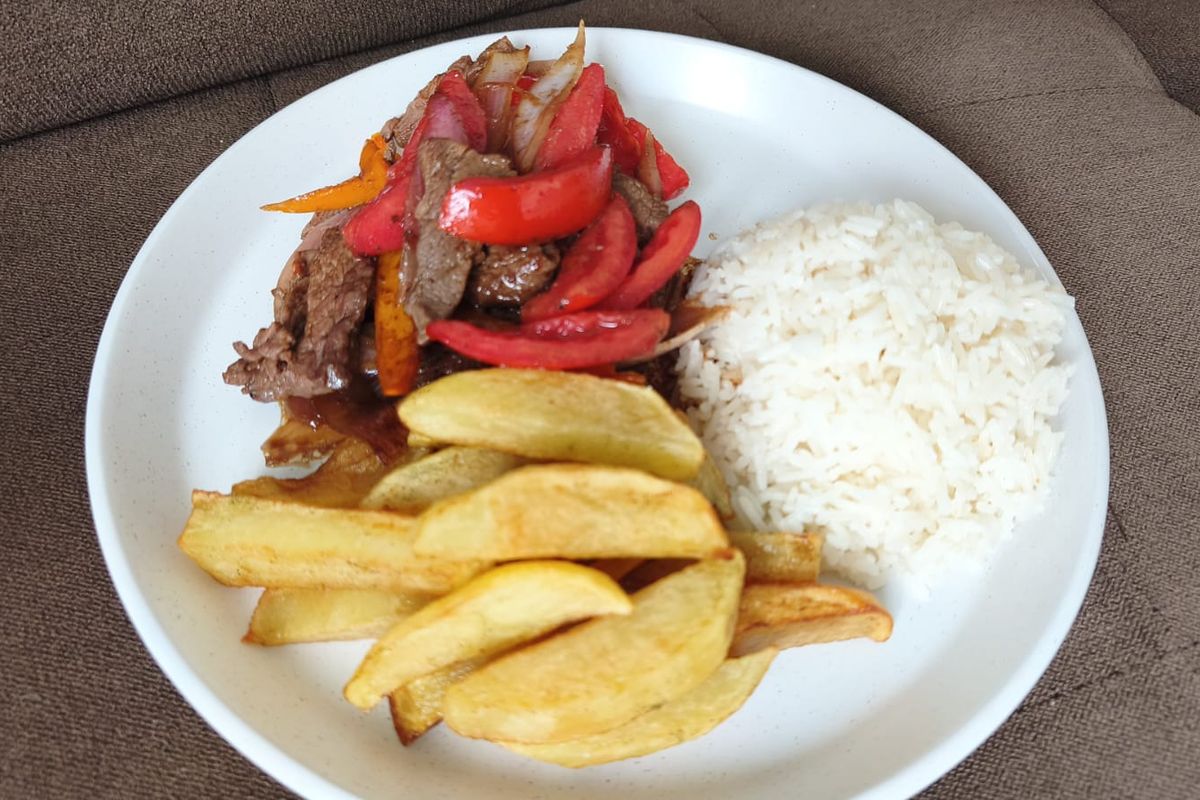
Thin strips of beef stir-fried over high heat with red onion, tomato, soy sauce and vinegar, then served with crisp oven fries and white rice.
By Lavin Food Editorial · Published
- Prep
- 30 min
- Cook
- 40 min
- Total
- 1 hr 10 min
- Yield
- 4 servings
About this dish
Lomo saltado is a Peruvian stir-fry. According to Wikipedia, it typically combines marinated strips of sirloin or another beef steak with onions, tomatoes, french fries and other ingredients, and it is usually served with rice. The marinade is normally vinegar, soy sauce and spices. The word saltado refers to stir-frying. Potatoes come from Peru and rice came from Asia, so a plate with both is often read as a picture of the dish's mixed roots.
Wikipedia says the dish began within chifa, the Chinese-Peruvian cooking tradition, which blends Cantonese elements with Peruvian ingredients. This is the widely accepted view. A 1903 Peruvian cookbook has a short entry for lomo saltado that mentions no soy sauce, vinegar or chiles, and some writers have used it to argue for a purely Peruvian origin. The article replies that the entry does not contradict the Chinese-Peruvian roots. The sources read here do not settle the question, and neither does this page.
This version is written for a home kitchen with one large skillet or a wok. The aim is beef that is browned outside and still tender, onions that keep a little bite, and a small amount of tangy, salty sauce that clings to everything. The fries bake in the oven, which keeps the pan free for the stir-fry. Have every part ready before the beef goes in.
Ingredients and substitutions
Quantities are for 4 servings.
For the beef
- 1½ pounds (680 g) beef sirloin steak, trimmed and sliced thin against the grain
- 1 tablespoon (15 ml) soy sauce
- 1 tablespoon (15 ml) red wine vinegar
- 3 cloves garlic, minced
- ½ teaspoon (1 g) ground cumin
- freshly ground black pepper, to taste
For the stir-fry and sauce
- 3 tablespoons (45 ml) vegetable oil, such as canola or peanut
- 2 medium (300 g) red onions, cut into thick wedges
- 2 medium (300 g) firm ripe tomatoes, cut into thick wedges
- 2 tablespoons (30 ml) soy sauce, for the sauce
- 1 tablespoon (15 ml) red wine vinegar, for the sauce
- 1 tablespoon (15 g) ají amarillo paste, see substitutions
- ¼ cup (60 ml) water
- ¼ cup (15 g) fresh flat-leaf parsley or cilantro, chopped
For the oven fries
- 1½ pounds (680 g) russet potatoes, cut into sticks about 3/8 inch (1 cm) thick
- 2 tablespoons (30 ml) vegetable oil, for the potatoes
- ¾ teaspoon (4 g) fine salt
For the rice
- 1½ cups (280 g) long-grain white rice
- 2¼ cups (540 ml) water, for the rice
- ½ teaspoon (3 g) fine salt, for the rice
Choosing your ingredients
Sirloin is the cut Wikipedia names, and it suits quick cooking. Flank steak, strip steak or tenderloin tips also work. What matters more is the slicing. Cut across the grain, the lines of muscle fiber you can see in the meat, into strips about 1/4 inch (6 mm) thick and 2 inches (5 cm) long. Chilling the steak in the freezer for 20 minutes makes it firm enough to slice thin.
Ají amarillo paste is a jarred paste of Peruvian yellow chile that gives the sauce a fruity warmth. It is sold in many Latin American grocery stores and online. Taste a little from the jar first, because brands differ in heat and salt. If you cannot find it, see the substitutions below.
Russet potatoes make fries with a fluffy center and crisp edges. Cut them evenly and dry them well, since water on the surface blocks browning. Frozen fries are a fair shortcut: bake them to the package directions and fold them in at the end. Choose firm tomatoes, because soft ones fall apart in seconds in a hot pan.
A wide, heavy skillet or a carbon-steel wok holds heat best. Thin pans lose heat as soon as the beef lands, and the meat then stews instead of browning.
Possible substitutions
- Ají amarillo paste: There is no exact match. For a similar fruity warmth, blend 2 tablespoons of roasted yellow or orange bell pepper with a pinch of cayenne. The result is milder and less fruity. You can also leave it out.
- Beef sirloin steak: Flank steak, strip steak or beef tenderloin, sliced thin across the grain.
- Red wine vinegar: White wine vinegar or apple cider vinegar, in the same amount.
- Red onions: Yellow onions. They taste sharper, so cook them 30 seconds longer.
- Russet potatoes: Yukon Gold potatoes, or about 1 1/2 pounds (675 g) of frozen fries baked to the package directions.
Step-by-step method
- Slice and marinate the beef. Trim any thick fat from the steak and slice it across the grain into strips about 1/4 inch (6 mm) thick. Toss the strips with the marinade soy sauce, the marinade vinegar, the garlic, the cumin and plenty of black pepper. Cover and refrigerate for 15 to 30 minutes while you make everything else. Do not marinate much longer, because the vinegar starts to make the meat soft.
- Bake the fries. Heat the oven to 450°F (230°C) with two rimmed baking sheets inside. Dry the potato sticks well and toss them with the potato oil and the salt. Spread them in one layer on the hot sheets and bake for 30 to 40 minutes, turning once after 20 minutes. They are ready when the edges are deep golden and crisp and a stick bends only a little when lifted.
- Cook the rice. Rinse the rice in a sieve until the water runs mostly clear. Combine it with the rice water and salt in a medium pot and bring to a boil. Cover, reduce the heat to low and cook for 15 to 18 minutes, until the water is absorbed and small steam holes show on the surface. Turn off the heat and leave it covered for 10 minutes, then fluff with a fork.
- Prepare the vegetables and sauce. Cut the onions and tomatoes into thick wedges, about 1/2 inch (1.2 cm) at the widest edge, so they stay in pieces in the hot pan. Stir the sauce soy sauce, the sauce vinegar, the ají amarillo paste and the water together in a small bowl. Chop the herbs. Set everything next to the stove, because the cooking from here takes only about 8 minutes.
- Sear the beef in batches. Heat a large skillet or wok over high heat for 2 minutes, until a drop of water vanishes at once. Add about a third of the stir-fry oil and half the beef in one layer. Leave it for 45 seconds until browned underneath, then stir for 30 to 60 seconds more. The strips should be browned all over with no raw pink left. Move to a bowl and repeat with the second half.
- Char the onions and tomatoes. Return the empty pan to high heat and add the remaining stir-fry oil. Add the onion wedges and cook for 1 to 2 minutes, tossing, until the edges brown and the centers are still crisp. Add the tomato wedges and cook for 30 to 60 seconds, just until their surfaces blister. They should hold their shape and not turn to pulp.
- Add the sauce and beef. Pour the sauce into the pan and let it bubble hard for 15 to 20 seconds. Return the beef and any juices from the bowl. Toss for 30 to 45 seconds, until the sauce has reduced to a glossy coating that clings to the beef and vegetables. Take the pan off the heat and stir in most of the herbs. Taste, and add a few drops of vinegar or soy sauce if it needs it.
- Fold in the fries and serve. Add the hot fries to the pan and fold them in gently with a spatula, only 10 to 15 seconds, so they pick up some sauce and keep some crunch. Spoon the rice onto plates, pile the lomo saltado beside or over it and finish with the remaining herbs. Serve right away, while the fries are still crisp.
Variations
For fried fries, fry the cut potatoes in a deep, heavy pot with about 2 inches (5 cm) of oil heated to 350°F (175°C), in small batches for 6 to 8 minutes. Use a thermometer, never fill the pot more than half full, dry the potatoes well so the oil does not spatter, and keep a lid nearby in case of fire. Never put water on a grease fire.
For a chicken version, use 1 1/2 pounds (675 g) of boneless chicken thighs cut into strips and cook until no pink remains and the thickest piece reaches 165°F (74°C). For a vegetarian plate, sear thick slices of portobello mushroom or pressed firm tofu in place of the beef.
Storage and reheating
Refrigerate leftovers within 2 hours of cooking, or within 1 hour if the room is above 90°F (32°C). Store the stir-fry, the rice and the fries in separate shallow airtight containers, because fries go soft in sauce. Cooked rice should not sit out. Everything keeps for 3 to 4 days in the refrigerator.
Reheat the stir-fry in a hot skillet until steaming and at least 165°F (74°C) throughout. Re-crisp the fries in a 425°F (220°C) oven for 8 to 10 minutes. The beef mixture freezes for about 3 months, though the tomatoes soften. Do not freeze the fries.
Common mistakes
- Crowding the pan. Too much beef drops the pan temperature, and the meat gives off liquid and turns gray. Cook in two batches, in a single layer.
- Cutting the beef with the grain. Strips cut along the fibers stay chewy even when cooked correctly. Find the direction of the lines in the meat and cut across them.
- Marinating for too long. Vinegar and soy sauce change the surface of the meat. After a few hours the strips can turn soft. Thirty minutes in the refrigerator is enough.
- Overcooking the vegetables. Onions and tomatoes should be seared quickly. If they simmer until limp, the dish loses texture and the sauce turns watery.
- Mixing in the fries too early. Fries left in the pan soak up sauce and go soft. Add them last, fold for a few seconds and get the plates to the table.
Frequently asked questions
Do I need a wok to make lomo saltado?
No. A large, heavy skillet works well. Whatever the pan, preheat it well and cook the beef in batches.
How do I know the beef is cooked safely?
Whole cuts of beef are considered safe at 145°F (63°C) followed by a short rest. These thin strips cook through in 1 to 2 minutes, so judge by color: browned all over with no raw pink. The sauce is mixed separately so that no raw marinade goes into the pan.
Is lomo saltado spicy?
It is mild here. One tablespoon of ají amarillo paste adds warmth and fruity flavor more than heat. For more heat, add a little more paste or sliced fresh chile.
What does saltado mean?
According to Wikipedia, saltado refers to a stir-fry. In Peru, dishes called saltados are commonly linked to Chinese cooking technique.