Middle East & Africa
Tabbouleh: Parsley Salad with Bulgur, Tomato and Lemon
A Levantine salad where hand-chopped parsley leads and fine bulgur plays a small part, dressed with lemon and olive oil in about 40 minutes.
By Lavin Food Editorial · Published
- Prep
- 40 min
- Cook
- 0 min
- Total
- 40 min
- Yield
- 6 servings
About this dish
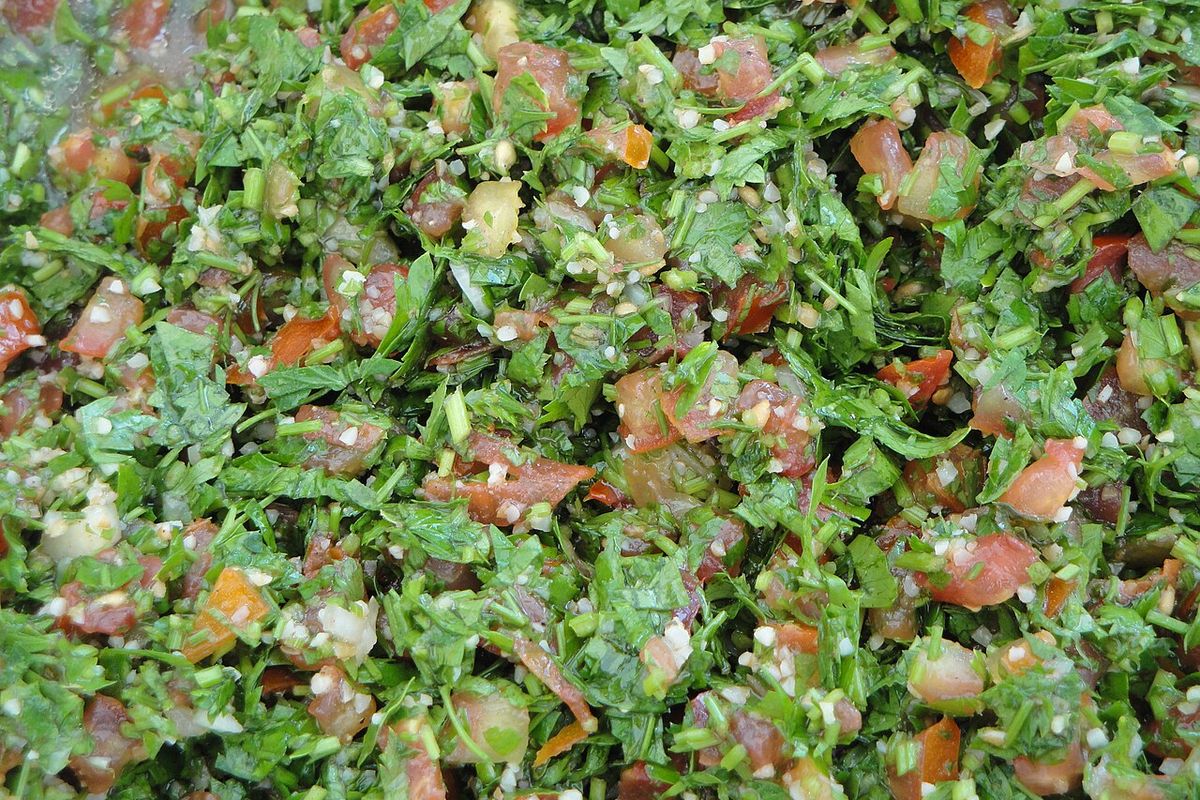
Tabbouleh is a Levantine salad of finely chopped parsley, soaked bulgur, tomatoes, mint and onion, seasoned with olive oil, lemon juice and salt. In the Arab world and the Eastern Mediterranean it is traditionally served as part of a mezze, the spread of small dishes that arrives together at the table.
Sources describe the dish as originating in the mountains of Lebanon and Syria. The Arabic name is said to come from a word linked to an Aramaic root meaning "seasoning" or, more literally, "dip," and the current spelling first appeared in the 1950s. Wikipedia also notes that a wheat variety called salamouni, grown in Lebanon's Beqaa Valley, was considered especially good for making bulgur in the mid-19th century. Beyond that, the early history is thinly documented, so it is wise to treat tidy origin stories with caution.
The balance of the salad is where cooks disagree. In Syria, Lebanon and Palestine, tabbouleh is usually mostly parsley with a small amount of bulgur, and Michael Solomonov has described Palestinian-made tabbouleh as "80 percent parsley." Turkish kısır and Armenian eetch use far more bulgur, and many western versions do the same. This recipe follows the parsley-first style: a big mound of green, a few spoonfuls of grain, and a sharp lemon dressing that is added late so the herbs stay bright.
Ingredients and substitutions
Quantities are for 6 servings.
For the salad
- ¼ cup (40 g) fine bulgur, #1 grind
- 3 medium (450 g) ripe tomatoes, firm, finely diced, juice saved
- 6 cups (180 g) flat-leaf parsley, leaves and thin stems, washed, dried and finely chopped
- ½ cup (12 g) fresh mint leaves, finely chopped
- 6 medium (90 g) scallions, thinly sliced
For the dressing
- ⅓ cup (80 ml) fresh lemon juice, from about 2 lemons
- ¼ cup (60 ml) extra-virgin olive oil
- 1 teaspoon (6 g) fine salt
- ¼ teaspoon (0.5 g) ground allspice, optional
- freshly ground black pepper, to taste
To serve
- 1 head romaine lettuce, small inner leaves, washed and dried, for scooping
Choosing your ingredients
Parsley is the main ingredient, so buy it with care. Flat-leaf (Italian) parsley has a cleaner, more grassy flavor than curly parsley, and its leaves are easier to chop into fine flecks. Look for bunches with deep green, upright leaves and no yellowing. Six cups of chopped leaves comes from roughly four large bunches. Keep the thin, tender stems near the leaves, because they add crunch, and discard only the thick, woody lower stalks.
Fine bulgur, often labeled #1, needs no cooking. It only has to soak in cold liquid until tender, which is why this recipe uses tomato juice and lemon instead of hot water. Medium and coarse bulgur are too hard for this method and would stay chewy. Bulgur is made from wheat, so check the package if you shop for someone who avoids it.
Tomatoes should be ripe but still firm, so they hold their shape when diced. Very soft tomatoes turn to pulp and make the salad wet. Dice them over a bowl and keep every drop of juice for the bulgur. In winter, plum or cherry tomatoes often taste better than large round ones.
Mint is a supporting herb here, not a co-star. Fresh mint only; dried mint tastes flat and dusty in this salad. Use a sharp knife and a light hand, because mint bruises and darkens when it is crushed or chopped too long. Good olive oil matters too, since there is no cooking to soften its flavor. Choose one you would happily dip bread in.
Possible substitutions
- Fine bulgur: Fine semolina, as some versions use, or cooked and cooled quinoa for a gluten-free salad. Quinoa needs no soaking, so skip the first step and mix it in with the dressing.
- Flat-leaf parsley: Curly parsley works if you chop it extra fine and remove the tougher stems. The flavor is milder and the texture a little fluffier.
- Scallions: Half a small red or white onion, minced very fine and rinsed under cold water for a gentler bite.
- Lemon juice: Freshly squeezed lime juice in the same amount. Bottled lemon juice tastes flat, so use it only if you have no fresh fruit.
- Ground allspice: A pinch of cinnamon, or a pinch of Lebanese seven-spice if you have it, or leave the spice out and use only black pepper.
- Romaine leaves: Little gem lettuce, cabbage leaves or warm pita for scooping.
Step-by-step method
- Soak the bulgur. Dice the tomatoes over a bowl so every bit of juice drops in. Tip the diced tomato into a sieve to drain and set it aside. Stir the bulgur into the juice with about a third of the lemon juice and let it stand 15 to 20 minutes, until the grains are plump and tender with a slight chew.
- Wash and dry the herbs. Wash the parsley and mint in cold water, then spin them in a salad spinner or shake well. Spread the herbs on a clean towel and let them air-dry for 10 to 15 minutes. They are ready when the leaves feel dry to the touch and no beads of water cling to them.
- Chop the parsley by hand. Gather a handful of parsley into a tight bundle and slice it thinly with a very sharp knife. Rock the blade through the pile once or twice more. Work in small batches for 10 to 15 minutes. The pieces should be fine, separate flecks, not a wet green paste. A food processor bruises the leaves and turns them to mush.
- Chop the mint and scallions. Strip the mint leaves from the stems, stack them and slice them thinly, then chop with only a few strokes. Over-chopping makes the edges darken. Slice the scallions into thin rings. Put all the herbs and scallions in a large, wide bowl and toss lightly. This takes about 5 minutes, and the mixture should look light, loose and bright green.
- Whisk the dressing. In a small bowl, whisk the olive oil with the remaining lemon juice, the salt, the allspice and some black pepper for about 1 minute, until the dressing turns slightly cloudy and thick. Taste a drop on a spoon. It should seem a little too sharp on its own, because the herbs and tomato will soften the acidity.
- Combine just before serving. Fluff the soaked bulgur with a fork. If liquid pools in the bowl, press it out. The grains should look moist, not wet. Add the bulgur and drained tomatoes to the herbs, pour in the dressing and fold gently for 30 to 60 seconds, until every flake glistens. Taste and adjust the salt and lemon.
- Rest briefly and serve. Let the salad stand for 5 to 10 minutes so the bulgur absorbs the dressing, and serve within about 30 minutes of dressing it. The herbs should still look bright green and stand up in the bowl, not lie dark and limp. Pile it onto a platter with the romaine leaves around it, and scoop spoonfuls into the leaves.
Variations
A bulgur-heavy tabbouleh is common outside the Levant and is popular in Israel. To try it, raise the bulgur to about three-quarters of a cup (120 g), soak it in the tomato juice plus a few extra tablespoons of water, and chop less parsley. The salad becomes more filling and less sharp. Kısır, a Turkish relative, goes even further and is built around the grain.
For a gluten-free bowl, swap the bulgur for cooked, cooled quinoa, or leave the grain out and add a diced cucumber for a fresh, parsley-forward salad. For more spice, stir in a pinch of Aleppo pepper or a little extra allspice. Some cooks add a handful of chopped pomegranate seeds for sweet-tart pops. Keep the proportions loose, but keep parsley as the main ingredient.
Storage and reheating
Tabbouleh is best on the day it is made. Once the dressing goes on, the herbs begin to soften and darken. If you want to prepare ahead, keep the pieces apart: store the chopped herbs wrapped in a dry paper towel in a sealed container, the soaked bulgur and tomato in another, and the dressing in a jar. Combine them shortly before serving.
Leftover dressed salad should be put in the refrigerator within 2 hours of serving, in a covered container, and eaten within 3 to 4 days, though the texture is best in the first day. Drain off any liquid at the bottom and add a squeeze of lemon and a drizzle of oil to wake it up. Do not freeze it, because parsley and tomato turn watery and limp after thawing.
Common mistakes
- Chopping wet herbs. Damp parsley smears under the knife and clumps together, and the water thins the dressing. Dry the leaves fully before cutting, and use a sharp blade so the leaves are sliced, not crushed.
- Using a food processor. A machine bruises the leaves and leaves a dark, wet paste with big uneven chunks. Hand chopping takes about 15 minutes and gives clean, light flecks that hold their color.
- Adding the dressing too early. Lemon and salt pull water out of the herbs and tomato and dull the green color. Dress the salad just before serving and rest it no more than 5 to 10 minutes.
- Soaking the bulgur in too much liquid. Extra water makes the grains swell and leaves the salad soggy. Use only the tomato juice and a little lemon, and press out any pooled liquid before mixing.
- Letting the bulgur take over. More grain gives a heavier, pasty salad that tastes of wheat instead of herbs. Keep it to a small amount so the parsley stays in front.
Frequently asked questions
Why is there so much parsley?
In the Levantine style, parsley is the main ingredient and bulgur is a small part. Sources describe Syrian, Lebanese and Palestinian versions as parsley-heavy, while many western and Turkish versions use more grain. This recipe follows the parsley-first style.
Does tabbouleh contain wheat?
Yes. Bulgur is made from wheat, so traditional tabbouleh contains it. Anyone who avoids wheat or gluten should check the label of the bulgur they buy, or use a different grain such as quinoa and confirm its packaging.
Can I make it ahead for a party?
Yes, in parts. Chop the herbs up to a day ahead and store them dry in a sealed container with paper towels. Soak the bulgur and dice the tomatoes the same day. Mix everything with the dressing within 30 minutes of serving.
Why does my tabbouleh turn watery?
Usually the herbs were damp, the tomatoes were too soft or the salad sat dressed too long. Dry the herbs well, drain the diced tomato and add the dressing late. Pour off any liquid that collects in the bowl.
How should I eat it?
In a mezze it is eaten with a spoon or scooped into romaine or cabbage leaves. Pita on the side is also common. It goes well next to grilled meat, falafel, hummus or other cold dishes.