Asia
Thai Green Curry with Chicken and Vegetables
Chicken thighs and vegetables simmered in coconut milk fried with green curry paste, finished with Thai basil and served over jasmine rice in about 50 minutes.
By Lavin Food Editorial · Published
- Prep
- 25 min
- Cook
- 25 min
- Total
- 50 min
- Yield
- 4 servings
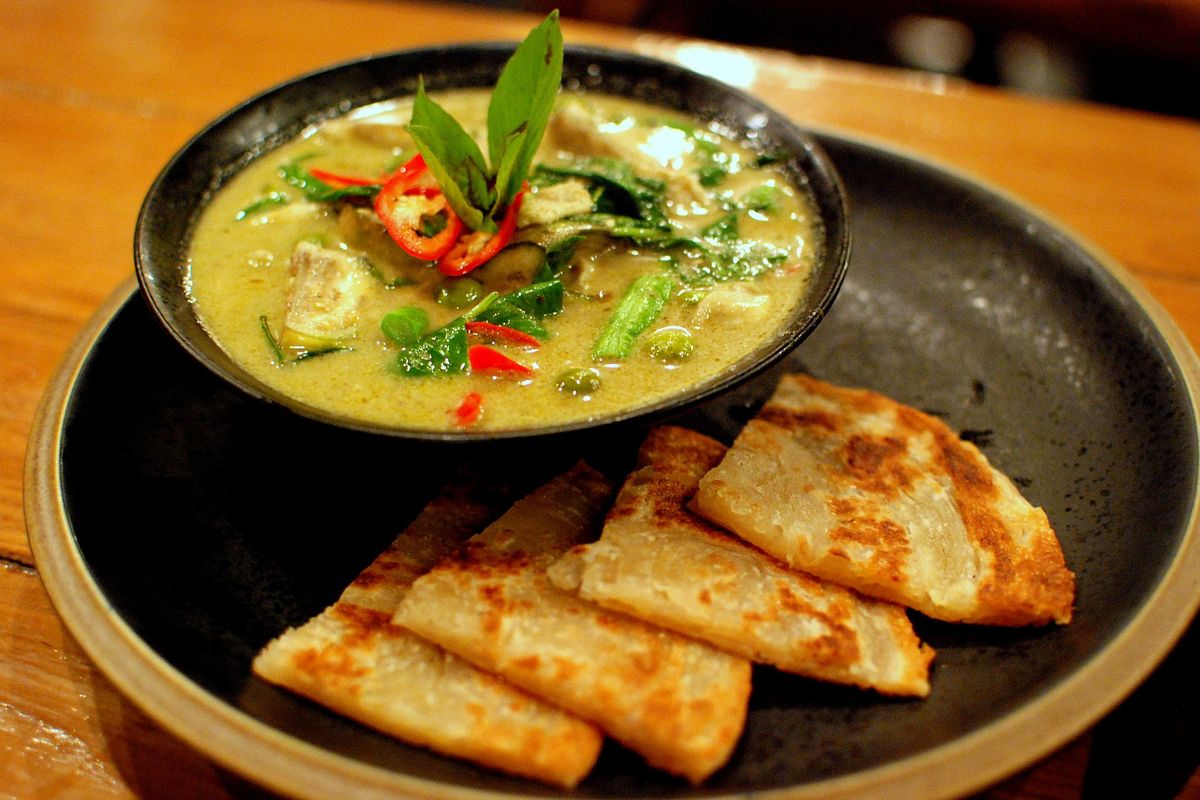
About this dish
Green curry is a Thai curry from the central part of the country. Its Thai name, kaeng khiao wan, is often translated as "sweet-green curry". Wikipedia explains that the word for sweet refers to the shade of green, not the taste, and that the color comes from fresh green chilies. The curry tends to be hotter than the milder red curries. The same article says it evolved during the reign of King Rama VI or Rama VII, between 1908 and 1926.
The base is a paste, not a powder, and Wikipedia's curry paste article notes that Thai cooking favors paste over curry powder. Traditionally it is pounded in a mortar from green bird's eye chilies, shallots, garlic, galangal, lemongrass, makrut lime peel, cilantro roots, cumin, white pepper, shrimp paste and salt. The paste is fried in the thick part of the coconut milk until the oil separates, then the rest of the coconut milk, palm sugar and fish sauce go in, and Thai basil and lime leaves finish it.
This version uses a store-bought paste, the practical choice for a weeknight, and boneless chicken thighs that stay tender in a gentle simmer. The aim is a creamy, fragrant sauce, balanced between sweet and salty, and as hot as you like. Serve it with jasmine rice, since green curry is usually eaten with rice as part of a wider meal.
Ingredients and substitutions
Quantities are for 4 servings.
For the curry
- 2 cans (800 ml) full-fat coconut milk, do not shake the cans
- 1 tablespoon (15 ml) neutral oil, only if the cream does not separate
- 3 tablespoons (50 g) green curry paste, plus more to taste
- 1½ pounds (680 g) boneless, skinless chicken thighs, cut into 1-inch (2.5 cm) pieces
- ½ cup (120 ml) chicken stock or water
- 4 leaves makrut (kaffir) lime leaves, torn in half, central rib removed
- 1 tablespoon (15 ml) fish sauce, plus more to taste
- 2 teaspoons (8 g) palm sugar or light brown sugar, grated or chopped
- 8 oz (225 g) eggplant, Thai eggplant quartered, or Japanese eggplant in 1-inch (2.5 cm) pieces
- 6 oz (170 g) green beans, trimmed and cut into 2-inch (5 cm) pieces
To finish and serve
- 1 cup (20 g) Thai basil leaves, loosely packed
- 1 tablespoon (15 ml) lime juice, from about 1 lime
- 1 medium mild red chili, such as Fresno, sliced thin, optional
- 1½ cups (280 g) jasmine rice, cooked following the package directions
Choosing your ingredients
Green curry paste is where the flavor lives. Brands differ a lot in heat and saltiness, so 3 tablespoons is a starting point. Most pastes contain shrimp paste, and fish sauce adds more, so read the label if you avoid fish or shellfish. Vegetarian pastes exist but are less common.
To make your own, blend about 8 green chilies, 3 shallots, 4 garlic cloves, a 1-inch (2.5 cm) piece of galangal, 1 trimmed lemongrass stalk, the zest of a lime, a handful of cilantro stems, 1/2 teaspoon each of toasted ground cumin and white pepper, 1 teaspoon shrimp paste and a pinch of salt, with a splash of water. This is a rough outline, so taste and adjust.
Use full-fat coconut milk and leave the cans unshaken. The thick cream rises to the top and is what you fry the paste in. Light coconut milk will not separate and gives a thin sauce. Some brands are blended smooth, so the tablespoon of oil helps the paste fry.
Thighs have more fat than breasts and stay juicy in a simmer. Thai basil has a clear anise note. Makrut lime leaves are sold fresh or frozen at Asian markets, and frozen ones work well.
Possible substitutions
- Thai basil: Sweet basil plus a few mint leaves. The flavor is softer and less anise-like.
- Makrut lime leaves: The zest of 1 lime, added with the lime juice at the end.
- Palm sugar: Light brown sugar in the same amount.
- Fish sauce: Light soy sauce, about 1 1/2 teaspoons, for a less funky result. This is not vegan if the paste contains shrimp paste.
- Eggplant: Zucchini or bamboo shoots. Add zucchini with the green beans.
- Chicken thighs: Chicken breast, cooked just to 165°F (74°C), or firm tofu and extra vegetables. Raw shrimp need only 3 to 4 minutes.
Step-by-step method
- Prepare everything and start the rice. Cut the chicken, eggplant and green beans, tear the lime leaves and pick the basil. Start the jasmine rice following the package directions, usually 15 to 20 minutes. Without stirring the cans of coconut milk, spoon the thick cream from the top into a bowl, about 1 cup (240 ml). Keep the thinner milk separate.
- Crack the coconut cream. Heat a wide pot over medium heat and add the coconut cream. Cook for 3 to 5 minutes, stirring now and then, until it bubbles, thickens and begins to separate, with shiny clear oil pooling at the edges. This is called cracking the cream. If it stays smooth after 5 minutes, stir in the tablespoon of oil.
- Fry the curry paste. Add the curry paste and break it up with a spoon. Fry for 2 to 3 minutes, stirring constantly, until it darkens slightly, smells strongly of chilies and lemongrass, and looks glossy. Lower the heat if it sticks. Frying removes the raw, sharp taste of the paste and gives the sauce depth.
- Coat the chicken. Add the chicken and stir to coat each piece in the paste. Cook for 2 to 3 minutes, until the outside turns from pink to white and no raw patches remain. It does not need to brown, since it will finish cooking in the sauce.
- Add the liquid and simmer. Pour in the remaining coconut milk and the stock. Add the lime leaves, fish sauce and sugar. Bring to a bare simmer, with small bubbles at the edges, and keep it there, because a hard boil makes the sauce greasy and the chicken tough. Simmer for 8 minutes, stirring now and then.
- Cook the vegetables. Add the eggplant and simmer for 4 minutes, then add the green beans and cook 4 to 5 minutes more. The eggplant should be tender when pierced, and the beans bright green and slightly crisp. The chicken is done at 165°F (74°C) in the largest piece, with clear juices, usually 12 to 15 minutes in total.
- Taste and adjust the heat. Taste the sauce. Add fish sauce a teaspoon at a time if it needs salt, and a pinch of sugar if it is sharp. If it is not hot enough, fry 1 more teaspoon of paste in a small pan with a little oil for 1 minute, then stir it in. Wait 2 minutes between tastes.
- Finish with basil and lime. Take the pot off the heat. Stir in the basil and lime juice and let the leaves wilt for 30 to 60 seconds, until fragrant and just darkened. Ladle the curry over the jasmine rice and scatter the sliced chili on top, if using. Serve right away.
Variations
Wikipedia notes that the ingredients of green curry are not fixed. Fish, fish balls and other meats are used, as are pea eggplants and other green or whitish vegetables. Try raw shrimp instead of chicken, added for the last 3 to 4 minutes, or cubed firm tofu with bamboo shoots or snow peas. The article also says it is served with round rice noodles called khanom jeen as a single dish.
For a milder bowl, use 2 tablespoons of paste. For more heat, increase the paste in small steps, or add sliced green bird's eye chilies with the basil. One brand of paste can be twice as hot as another.
Storage and reheating
Refrigerate the curry within 2 hours of cooking, in a shallow airtight container, for 3 to 4 days. The coconut fat may set into a layer on top, which melts again when heated. Cool the cooked rice quickly and store it separately.
Reheat in a pot with a splash of water, stirring until steaming hot, to 165°F (74°C). Add fresh basil at the end. It freezes for about 3 months for quality, but the eggplant turns soft and the sauce may look grainy. Stir well as it reheats.
Common mistakes
- Skipping the frying step. Paste stirred straight into liquid tastes raw and sharp. Fry it in the cracked cream for 2 to 3 minutes until the aroma is strong.
- Boiling the curry hard. A fast boil splits the sauce into oily streaks and toughens the chicken. Keep it at a bare simmer.
- Adding all the paste at once. Pastes vary widely in heat. Start with 3 tablespoons and add more at the end, in small amounts.
- Cooking the basil too long. Boiled basil turns dark and loses its scent. Stir it in off the heat.
- Using light coconut milk. It will not crack and gives a thin, flat sauce. Use full-fat milk and add a little extra stock if you want it lighter.
Frequently asked questions
Can I use ready-made green curry paste?
Yes. This recipe is written for a store-bought paste. Check the label for shrimp paste if you avoid fish or shellfish, and taste as you go, since heat and salt differ by brand.
Why does the sauce look oily?
Some oil is expected, because frying paste in cracked cream releases it. A greasy, split sauce usually means it boiled too hard, so lower the heat and stir in a splash of stock.
How do I know the chicken is cooked?
Poultry is safe at 165°F (74°C). Check the largest piece with a thermometer, or cut it open and look for opaque white meat with clear juices.
How hot is this curry?
That depends on the paste. A mild brand tastes gentle, and a hot brand can feel fierce. Start with 2 tablespoons if unsure and add more at the end.